Transformed at the Tomb: How a New Generation of American Christians Is Finding Themselves in Jerusalem
Sarah Kowalski had attended the same evangelical megachurch in suburban Nashville for most of her adult life. She sang in the worship band, volunteered at the food pantry, and considered herself, by any reasonable measure, a committed Christian. But when she stepped through the entrance of the Church of the Holy Sepulchre on a gray March morning at the age of thirty-one, she found herself doing something she had not done in years: weeping without quite knowing why.
"I had seen photographs of the place a thousand times," she said, speaking from her home several months after returning from Jerusalem. "But being there—touching the stone where they say the cross stood—it made everything I'd believed feel suddenly real in a way I hadn't expected. Like the faith I'd been carrying was suddenly grounded in something physical."
Sarah's experience is not unusual. Across the United States, a broadening and increasingly diverse cohort of Christian pilgrims is making the journey to Jerusalem with intentions that go well beyond sightseeing. They are arriving at the Church of the Holy Sepulchre—the site that has served as the axis of Christian devotion for seventeen centuries—not merely to observe history but to interrogate it, to feel it, and, in many cases, to be remade by it.
A Pilgrimage Culture Resurgent
The practice of Christian pilgrimage has deep roots, of course. Medieval Europeans walked hundreds of miles to venerate relics and sacred sites, and the Church of the Holy Sepulchre has been a destination for Western pilgrims since at least the fourth century, when Constantine's mother, Helena, reportedly identified the site and the emperor ordered the construction of the first basilica there. For much of American Protestant history, however, pilgrimage as a formal spiritual practice was viewed with some suspicion—associated with Catholic and Orthodox traditions that emphasized the sacred power of specific places and physical objects.
That cultural hesitancy appears to be softening. Religious scholars who study American Christianity note that younger generations—broadly described as Millennials and Generation Z—are increasingly drawn to experiential, embodied expressions of faith that transcend denominational boundaries. The desire to see, touch, and physically inhabit the spaces where Christian history unfolded is, for many of these pilgrims, a response to what they perceive as an excess of abstraction in contemporary American church culture.
"There's a growing hunger for what theologians sometimes call 'thick' religious experience," explains Dr. Miriam Holt, a professor of religious studies at a university in the Pacific Northwest who has accompanied student pilgrimage groups to Jerusalem on three occasions. "Young people who have grown up with worship experiences that are highly produced and emotionally managed are often looking for something that feels ancient, unmediated, and real. The Church of the Holy Sepulchre, with all its complexity and rawness, offers exactly that."
What the Church Actually Offers
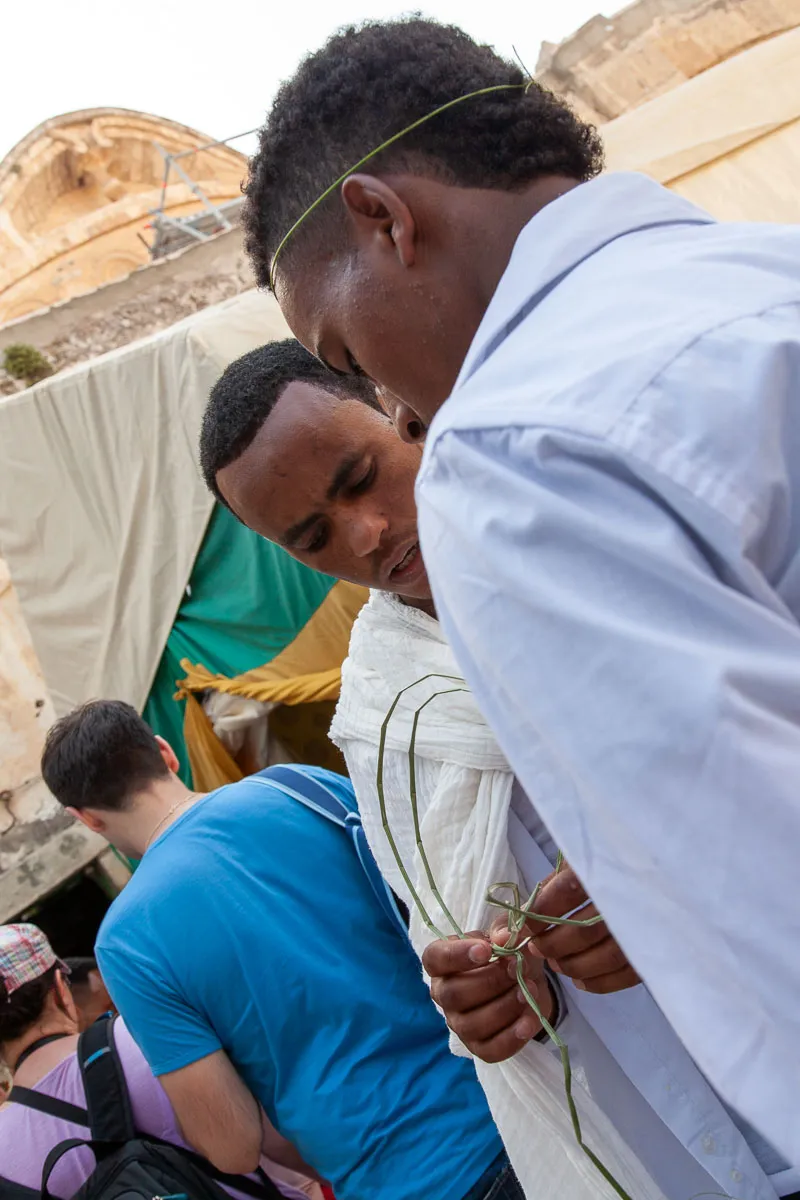
The Church of the Holy Sepulchre is not a comfortable space in any conventional sense. It is dim, crowded, and architecturally intricate in ways that can initially disorient visitors accustomed to the clean sightlines of modern American church buildings. Different sections of the church are maintained by different Christian denominations—Greek Orthodox, Roman Catholic, Armenian, Coptic, Ethiopian, and Syriac communities each hold custodial rights over specific areas—and the liturgical rhythms of these various communities overlap, intersect, and occasionally compete in ways that can feel cacophonous to unprepared visitors.
And yet it is precisely this quality—the sense of encountering something that has not been curated for American sensibilities—that many pilgrims describe as central to its impact.
Marcus Delray, a thirty-eight-year-old pastor from Atlanta who led a congregation trip to Jerusalem last spring, described standing at the Edicule—the ornate shrine built over the traditional site of Christ's tomb—while Greek Orthodox monks chanted behind him and a group of Filipino pilgrims prayed quietly ahead of him. "I realized I was standing inside the oldest living argument in the world," he said. "And somehow that made it more sacred, not less. This place has been contested and loved and broken and restored for two thousand years. That's not a problem. That's the testimony."
The Psychological Dimension of Sacred Space
Researchers who study the psychology of religious experience have increasingly turned their attention to pilgrimage as a distinct category of spiritual encounter. Unlike worship within a familiar community, pilgrimage involves deliberate physical displacement—the pilgrim removes herself from the routines and social structures that ordinarily define her religious life and enters a liminal space where ordinary identity is temporarily suspended.
The Church of the Holy Sepulchre amplifies this effect. Because it is identified in Christian tradition as the site of the most consequential events in human history—the crucifixion, burial, and resurrection of Jesus—the psychological weight that pilgrims bring to it is unlike that associated with almost any other destination. Many report that the experience of physically moving through the church's spaces—ascending the steps to Golgotha, descending to the Chapel of St. Helena, waiting in line to enter the Edicule—produces a kind of narrative embodiment that intellectual or devotional engagement alone cannot replicate.
"There's something that happens when you're not just reading about these events or hearing a sermon about them, but actually walking through the geography of them," said Dr. Holt. "The body registers meaning differently than the mind does. Pilgrims often describe a sense of confirmation—not proof, exactly, but a felt sense that the story they've been told is connected to something real and specific in the world."
Challenging and Deepening American Faith
Not every pilgrim returns from Jerusalem with their existing faith simply reinforced. For some, the encounter with the Church of the Holy Sepulchre raises questions that are genuinely unsettling. The site's denominational complexity can challenge assumptions about Christian unity. The knowledge that the historical and archaeological record is far more ambiguous than Sunday school narratives typically suggest can produce what scholars call "productive dissonance"—a discomfort that, when engaged seriously, leads to a more mature and durable faith.
Sarah Kowalski, the Nashville worship musician, describes her return home as the beginning of a longer spiritual process rather than a conclusion. "I came back asking different questions," she said. "Not bigger doubts, necessarily, but better ones. The Church of the Holy Sepulchre made my faith more complicated and more honest at the same time. I'm still figuring out what to do with that."
For American Christians navigating a religious landscape that is simultaneously more fragmented and more globally connected than at any previous point in the nation's history, that quality of honest complexity may be precisely what a pilgrimage to Jerusalem uniquely provides. The Church of the Holy Sepulchre does not resolve the tensions of Christian faith. It holds them, as it has always held them, within its ancient and layered walls.