The Immovable Ladder and the Living Keys: Inside the Ancient Custodianship That Governs Christianity's Holiest Church
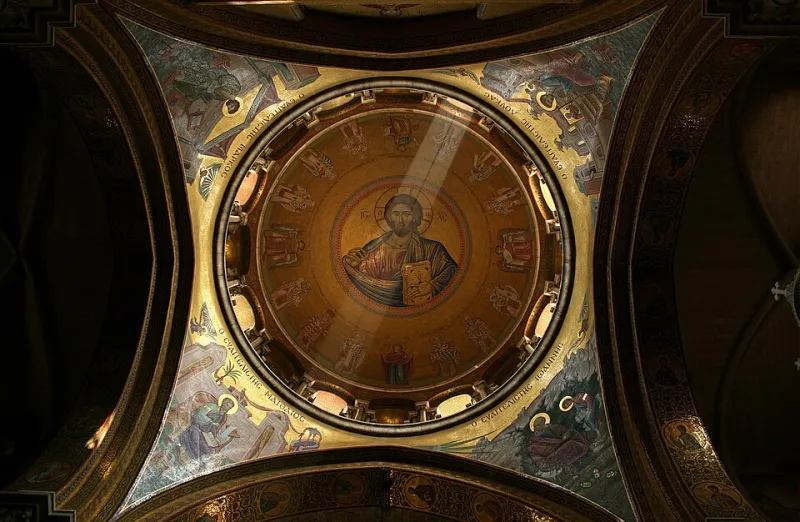
Photo: Diego Delso, CC BY-SA 3.0, via Wikimedia Commons
The Man Who Holds the Key
Each morning before dawn in the Christian Quarter of Jerusalem's Old City, a member of the Joudeh family retrieves an iron key that is approximately a foot long and several centuries old. He carries it to the entrance of the Church of the Holy Sepulchre, where a member of the Nuseibeh family — the appointed doorkeepers — uses it to unlock the massive wooden doors. The church opens. Christianity's holiest site begins another day.
Neither the Joudeh nor the Nuseibeh family is Christian. Both are Muslim. The Joudeh family has held custody of the key since the 13th century, when Saladin entrusted it to their ancestor following the Muslim recapture of Jerusalem. The Nuseibeh family has served as doorkeepers for nearly as long. This arrangement, which strikes many first-time visitors as extraordinary, is in fact one of the more stable features of a governance system that has endured — through wars, earthquakes, fires, and the collapse of empires — for the better part of a millennium.
Understanding who controls the Church of the Holy Sepulchre, and how, requires a journey not just through the church's physical spaces but through its layered institutional history.
Six Communities, One Church, Centuries of Tension
The church is formally shared by six Christian denominations: the Greek Orthodox, Roman Catholic (represented by the Franciscan Custody of the Holy Land), Armenian Apostolic, Coptic Orthodox, Ethiopian Orthodox, and Syriac Orthodox communities. Each has been assigned specific chapels, altars, and ceremonial rights through a framework known as the Status Quo — a set of arrangements largely codified in the 18th century under Ottoman rule and affirmed by subsequent governing powers, including the British Mandate and the modern State of Israel.
The Status Quo is not a formal legal document so much as a living tradition, and its ambiguities have generated disputes that range from the theological to the absurdly specific. In 2008, a physical altercation between Greek Orthodox and Armenian clergy broke out during a procession, requiring Israeli police intervention. In 2004, a Coptic monk moved his chair from its assigned location into the shade on a hot day; the Greek Orthodox community interpreted this as a territorial claim, and the resulting confrontation left several people injured.
These incidents, reported with some bemusement in the American press, tend to obscure the more fundamental reality: that this system of shared custody, however imperfect, has kept the church functioning and accessible for centuries in a city where religious claims have repeatedly produced catastrophic conflict.
The Three Primary Guardians
While all six communities hold rights within the church, three — the Greek Orthodox, the Armenian Apostolic, and the Roman Catholic Franciscans — exercise the most significant day-to-day authority. Together, they hold joint responsibility for the common areas of the church, including the Rotunda housing the Edicule, the main nave, and the Stone of Anointing.
The Greek Orthodox Patriarchate of Jerusalem holds the largest share of the church's interior, including the Catholicon, the central nave used for major liturgical celebrations. The Armenians control the Chapel of St. Helena and a substantial portion of the southern transept. The Franciscans, who have maintained a continuous presence in Jerusalem since the 14th century, administer the Chapel of the Apparition and the primary Latin altar.
Each community maintains a residential presence within or immediately adjacent to the church. Greek Orthodox monks occupy chambers in the upper gallery. Franciscan friars live in a convent attached to the church's western facade. Armenian clergy reside in quarters connected to their chapel complex. This is not merely administrative proximity — it is a form of physical witness, a daily assertion of presence that carries centuries of theological and political weight.
The Immovable Ladder
No single object in the church captures the peculiarities of the Status Quo more vividly than a wooden ladder that has rested on a ledge above the church's main entrance for at least two hundred and fifty years. It appears in an engraving dated to 1728 and has not been moved since — because no single community can agree on who has the authority to move it.
The ladder sits in a zone of shared jurisdiction. To relocate it would require the consent of all parties, a consensus that has never materialized. It has become, improbably, one of the most photographed objects in Jerusalem: a symbol of institutional stasis that manages to be both absurd and oddly poignant.
For American visitors who encounter it — often after being told its story by a guide — the ladder tends to provoke a specific kind of reflective pause. "It sounds like a joke at first," said Patricia Donnelly, a parish administrator from Portland, Oregon, who visited the church as part of a diocesan pilgrimage. "And then you think about it a little longer and it's actually kind of moving. Nobody moved the ladder because nobody wanted to be the one to break the peace. That's not nothing."
Daily Life Within the Arrangement
For the clergy who live and serve within the church, the governance framework is not an abstraction but a daily operational reality. Liturgical schedules must be coordinated to prevent overlapping ceremonies in shared spaces. Restoration projects require multi-party approval. Even the lighting of certain lamps follows protocols that specify which community bears responsibility.
Father Athanasius, a Greek Orthodox monk who has served in the church for more than a decade (his surname withheld at his request), described the arrangement with measured pragmatism. "We know each other," he said. "We know when to step back, when to speak, when to be silent. It is not always easy. But this church has survived because people learned to live with difficulty."
Coptic clergy, who maintain a rooftop chapel and a small monastery on the church's exterior, have faced particular pressures in recent years, as ongoing disputes with the Ethiopian Orthodox community over adjacent spaces have occasionally required diplomatic intervention. The Ethiopian community, which occupies a cluster of modest structures on the church's roof, represents perhaps the most precarious position in the entire custodial arrangement — present, but perpetually negotiating the terms of that presence.
What American Christians Make of All This
For many Americans raised in traditions that prize institutional clarity — or who belong to denominations where a single governing board makes decisions by majority vote — the Church of the Holy Sepulchre's custodial system can feel disorienting. The fragmentation appears, at first glance, to contradict the church's very function as a site of Christian unity.
Yet scholars of ecumenism and church history tend to offer a more nuanced reading. The arrangement at the Church of the Holy Sepulchre is, in its own way, a record of how different communities have held their claims to sacred space without annihilating one another. The disputes are real. The tensions are genuine. But the church stands, the doors open every morning, and the liturgies continue.
"Every denomination thinks it has the cleanest theology and the most sensible governance," said the Reverend Thomas Albright, a United Methodist minister from Atlanta who has led pilgrimages to Jerusalem for fifteen years. "And then you walk into that church and you see six communities sharing one roof and somehow making it work, and you think: maybe the mess is part of the point."
The key passes from the Joudeh family to the Nuseibeh family to the lock in the door. The ladder remains on its ledge. The lamps burn in their assigned positions. And the guardians, each carrying their centuries of history, continue their patient, complicated vigil.