Photographing the Sacred: What Happens When American Pilgrims Bring Their Phones Into the Church of the Holy Sepulchre
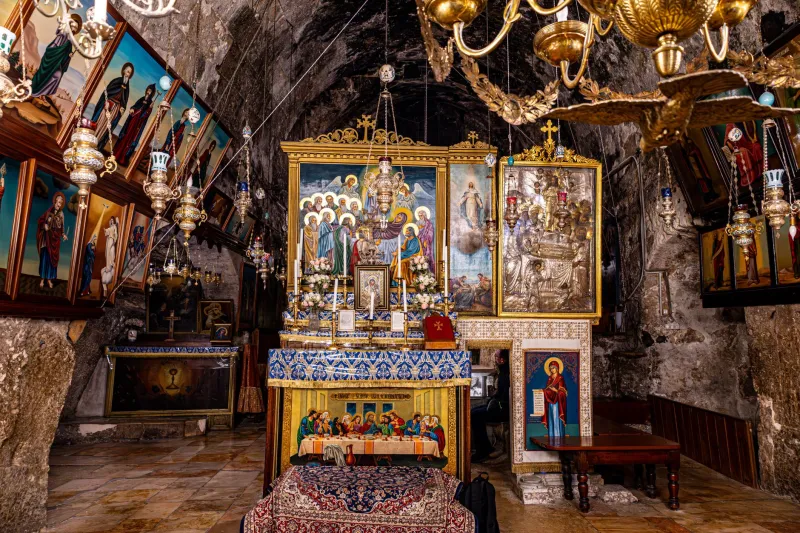
On any given morning inside the Church of the Holy Sepulchre, the scene is both ancient and unmistakably contemporary. Incense rises toward vaulted ceilings blackened by centuries of candlelight. Pilgrims from a dozen nations queue in silence outside the Edicule, the small shrine built over the tomb where Christians believe Christ rose from the dead. And amid the murmured prayers and soft footsteps, a familiar blue glow pulses from dozens of outstretched hands.
The smartphone has arrived in Jerusalem — and it has not come quietly.
For American pilgrims in particular, the instinct to photograph a significant moment is nearly reflexive. It is woven into the fabric of contemporary life, from family milestones to travel experiences to the ordinary rhythms of a Tuesday afternoon. To visit one of the most spiritually charged locations on earth and not document it can feel, to some, almost unnatural. Yet inside the Church of the Holy Sepulchre, that instinct encounters something it rarely meets elsewhere: two thousand years of contemplative tradition that has never once required a camera.
The Impulse to Capture
Marcia Holt, a fifty-three-year-old Methodist from Columbus, Ohio, had planned her pilgrimage to Jerusalem for nearly a decade. She arrived at the Church of the Holy Sepulchre on a Tuesday morning in spring, phone already in hand.
"I wanted my daughters to see it," she said. "They couldn't make the trip. I thought, if I can bring this back to them somehow, that matters."
Holt is not unusual. Research on religious tourism consistently shows that American travelers are among the most active documenters of sacred sites worldwide. The behavior is not irreverence — most pilgrims describe it as a desire to extend the experience, to share meaning across distance, to testify in the most literal modern sense of that word.
But Holt's experience inside the church complicated her intentions. Standing at the Stone of Anointing — the marble slab where tradition holds that Christ's body was prepared for burial — she raised her phone, then lowered it.
"Something stopped me," she said. "I can't explain it exactly. It felt like I was about to do something wrong. Not wrong like breaking a rule. Wrong like missing the point entirely."
What the Church Allows, and What It Asks
The Church of the Holy Sepulchre imposes no formal prohibition on photography in most of its spaces. Visitors are generally permitted to take photographs throughout the church, though clergy of the various custodial communities — Greek Orthodox, Roman Catholic, Armenian Apostolic, Coptic, Ethiopian, and Syriac Orthodox — may request that cameras be lowered during active liturgical services.
Yet the absence of a rule does not resolve the question. Father Emmanuel Petrakis, a Greek Orthodox priest who has served at the church for more than fifteen years, describes a distinction he observes daily between pilgrims who photograph and those who simply stand in silence.
"The camera creates a frame," he said. "When you hold it up, you are deciding what is important, what fits inside the rectangle. But this place does not fit inside a rectangle. The question is not whether you are allowed to take a photograph. The question is what you are doing with your attention."
That distinction — between permission and wisdom — sits at the heart of the conversation American pilgrims are increasingly having with themselves and with one another.
Digital Witness or Digital Distance?
Dr. Lauren Ashby, who studies digital culture and religious practice at a university in the Pacific Northwest, argues that the smartphone's role at sacred sites is more ambiguous than critics typically allow.
"There's a tendency to frame this as a binary," she said. "Either you're fully present, or you're behind a screen. But for many people, the act of framing something, of deciding it's worth preserving, is itself a form of attention. It can be an act of reverence."
She points to the long tradition of religious visual culture — the illuminated manuscript, the devotional painting, the pilgrimage souvenir — as evidence that Christians have always sought tangible ways to carry sacred encounters home. "The smartphone is, in some ways, a contemporary extension of that impulse," she said. "What's new is the immediacy, the shareability, and the sheer volume."
That volume is precisely what concerns others. On any given day, images tagged with the Church of the Holy Sepulchre appear across Instagram, TikTok, Facebook, and X, ranging from the genuinely moving to the casually touristic. A selfie taken at the entrance of the Edicule. A short video capturing the chanting of monks during the Divine Liturgy. A reel edited to trending audio, set against the stone walls of Golgotha.
"When the tomb becomes a backdrop," said one American Catholic pilgrim who asked not to be named, "something has been lost. I don't know exactly what. But something."
The Moment of Choice
What emerges from conversations with American pilgrims is less a consensus than a pattern of reckoning. Many describe arriving at the church with full intention to document their experience and leaving with a more complicated relationship to that plan.
David Carruthers, a thirty-eight-year-old evangelical pastor from Nashville, Tennessee, came to Jerusalem as part of a church-sponsored study trip. He photographed extensively during his first day at the site. On his second visit, he left his phone in his bag.
"I realized I had spent most of the first visit thinking about the photograph," he said. "Thinking about the caption. Thinking about how to explain what I was seeing to people back home. And I had not actually been there. Not fully."
His second visit, he said, was entirely different. "I stood inside the Edicule for probably four minutes. No phone. Nothing to do except be there. It was the most significant four minutes of my spiritual life."
Holt, the Methodist from Columbus, ultimately took a handful of photographs before she left the church — not of the Stone of Anointing, but of the church's exterior, the courtyard, the light falling through an upper window. "I have the pictures," she said. "But what I actually brought home wasn't in any of them."
Presence as Practice
The Church of the Holy Sepulchre has endured empires, earthquakes, and centuries of theological contest. It has received pilgrims carrying oil lamps and palm fronds, crusaders in armor, penitents barefoot on cold stone. It now receives pilgrims carrying devices capable of broadcasting their experience to thousands of people within seconds.
The church absorbs all of it, as it always has, with a kind of impassive permanence. What it cannot do is make the choice for those who enter.
That choice — between documentation and dwelling, between sharing and simply being — belongs entirely to the pilgrim. And according to those who have stood at the empty tomb and felt something shift inside them, it may be one of the most consequential choices they make on the entire journey.
Father Petrakis, when asked what he would say to an American pilgrim uncertain about whether to photograph, offered a single question in return.
"Ask yourself," he said, "what you came here to find. And then ask whether the camera helps you find it, or helps you avoid it."