One Church, Two Convictions: How American Christians Wrestle With the Geography of the Crucifixion
There is a moment that many American pilgrims describe upon entering the Church of the Holy Sepulchre for the first time — a suspension of ordinary time, a sudden awareness that the ground beneath their feet carries the weight of two millennia of devotion. But for visitors from the United States, that moment is frequently followed by a quieter, more disorienting realization: the church they have entered does not belong to their denomination alone, and the sacred sites within its walls are not universally agreed upon.
At the center of this ambiguity stands Golgotha — the hill of the skull, the place where Christian tradition holds that Jesus of Nazareth was crucified. Within the Church of the Holy Sepulchre, the site venerated as Calvary is enshrined on an upper chapel level, draped in the liturgical traditions of Roman Catholicism and Eastern Orthodoxy. Yet a significant portion of American Protestant visitors arrive in Jerusalem having been raised with a competing claim: that a rocky outcropping north of the Old City walls, known as the Garden Tomb, more authentically represents the true site of the crucifixion and resurrection.
Understanding why these two traditions diverge — and what that divergence means for the pilgrim standing at the threshold of Christianity's holiest shrine — requires a journey through history, theology, and the remarkably human need to locate the sacred in physical space.
The Ancient Claim and Its Architecture
The case for the Church of the Holy Sepulchre as the authentic site of the crucifixion and burial of Jesus is, by scholarly consensus, extraordinarily well-documented. The church's origins trace to the early fourth century, when Emperor Constantine ordered construction on a site that local Christian communities had preserved and venerated for generations. The historian Eusebius of Caesarea recorded that the location had been identified and protected even during periods of Roman occupation, when a temple to Venus was constructed over it — an act of erasure that paradoxically served to mark the site's significance in collective memory.
Archaeological excavations conducted in the twentieth and twenty-first centuries have continued to strengthen the historical case. Scholars have confirmed that the area now enclosed by the church was indeed outside the city walls during the first century, consistent with the Gospel accounts of crucifixion occurring beyond Jerusalem's boundaries. The bedrock of Golgotha, visible through glass panels in the chapel floor, has been dated to the correct geological period. For Roman Catholic and Eastern Orthodox pilgrims, the weight of this evidence, combined with an unbroken chain of veneration stretching back to the earliest Christian centuries, makes the identification essentially settled.
The Protestant Counternarrative and Its Appeal
The Garden Tomb, by contrast, was identified as a candidate site only in the nineteenth century — first proposed by the British General Charles Gordon in 1883. Gordon was struck by the visual resemblance of a nearby cliff face to a human skull, which he believed corresponded to the Gospel description of Golgotha, and by the presence of a rock-cut tomb in the adjacent garden. His theory gained rapid traction among certain Protestant communities in Britain and the United States, in part because it offered a visually compelling, emotionally accessible alternative to the crowded, incense-filled interior of the Church of the Holy Sepulchre.
For many American evangelical and mainline Protestant visitors, the appeal of the Garden Tomb is not primarily archaeological — most contemporary scholars regard the site's identification as historically untenable, noting that the tomb itself predates the first century by several hundred years. Rather, the appeal is experiential and theological. The Garden Tomb is quiet, green, and unhurried. It invites individual reflection in a way that the liturgically dense interior of the Church of the Holy Sepulchre, with its competing processions and incense clouds and multilingual prayers, does not always accommodate.
This distinction points to something deeper than historical disagreement. It reflects a fundamental divergence in how Protestant and Catholic traditions approach the relationship between place, memory, and worship.
What the Disagreement Actually Reveals
For Roman Catholic and Orthodox Christians, the accumulated weight of centuries of pilgrimage, liturgy, and communal prayer is itself a form of evidence — not merely sentimental, but spiritually and even historically meaningful. The fact that millions of believers across two thousand years have knelt at the same stone, wept before the same altar, and received the same sacraments in the same space is understood as a form of living testimony. The church is not simply a building that marks a location; it is the location, transformed and sanctified by continuous human encounter with the divine.
Protestant theology, shaped by the Reformation's suspicion of institutional mediation and its emphasis on scripture as the primary authority, tends to approach sacred sites differently. The concern is not that Golgotha cannot be located, but that no physical location should be permitted to monopolize or institutionalize access to the risen Christ. In this reading, the Garden Tomb's relative historical obscurity is almost beside the point; what matters is that the space invites a direct, unmediated encounter with the Gospel narrative.
American pilgrims — shaped by a religious culture that prizes personal experience and individual conviction — often find themselves caught between these two orientations in ways that feel surprisingly urgent once they are standing inside the Church of the Holy Sepulchre.
Navigating the Divide on Holy Ground
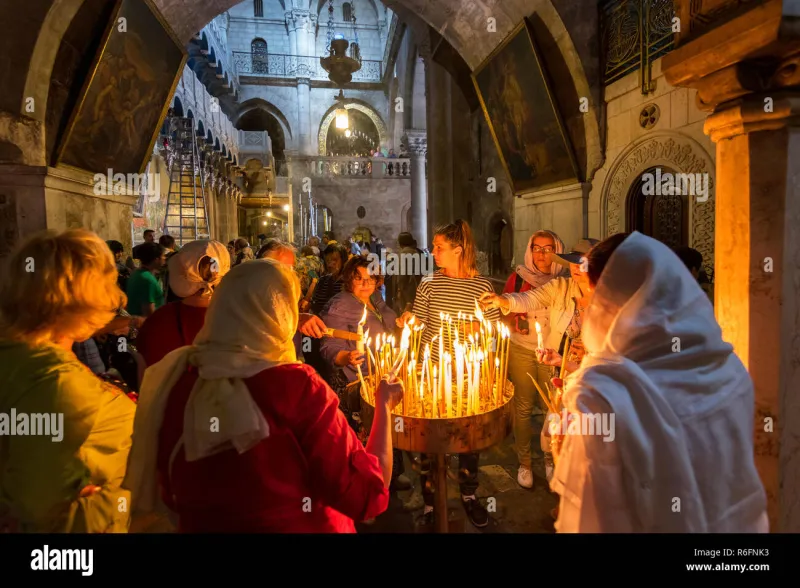
Many American visitors to the Church of the Holy Sepulchre describe a process of gradual adjustment, a recalibration of expectation that can feel disorienting at first and illuminating in retrospect. Protestant pilgrims who arrive anticipating a quiet, garden-like encounter with scripture frequently find themselves unexpectedly moved by the density of devotion they witness — the elderly Greek Orthodox woman pressing her forehead against the Stone of Anointing, the Franciscan friar leading a candlelit procession through the nave, the line of pilgrims waiting patiently to enter the Aedicule and touch the slab where tradition holds that Christ's body was laid.
Catholic and Orthodox visitors, for their part, sometimes report a renewed appreciation for the stripped-down directness of Protestant devotion — the willingness to sit with a Gospel text in an open garden and ask, without ceremony, what it means.
Pilgrimage directors who lead American groups through Jerusalem increasingly speak of the Golgotha question not as a problem to be resolved but as a productive tension to be inhabited. The disagreement, in their view, is itself a form of theological education — a live encounter with the reality that Christian faith has never been monolithic, and that the sacred does not always submit to the categories we bring to it.
The Ground Holds the Question
What the Church of the Holy Sepulchre offers the American pilgrim — Protestant, Catholic, or otherwise — is not a simple answer to the question of where Jesus was crucified. It offers something more demanding: an invitation to stand inside the full complexity of Christian history and ask what it means to believe that a specific place on earth was changed, permanently and irrevocably, by what happened there.
The scholarly consensus may favor the ancient church over the Victorian garden. But the deeper question — what it means to locate the sacred, to need it to be somewhere — belongs to every tradition equally. And it is a question that the stones of the Church of the Holy Sepulchre have been holding, patiently and without resolution, for nearly seventeen hundred years.