From O'Hare to the Anastasis: An American's Field Guide to Your First Visit at the Holy Sepulchre
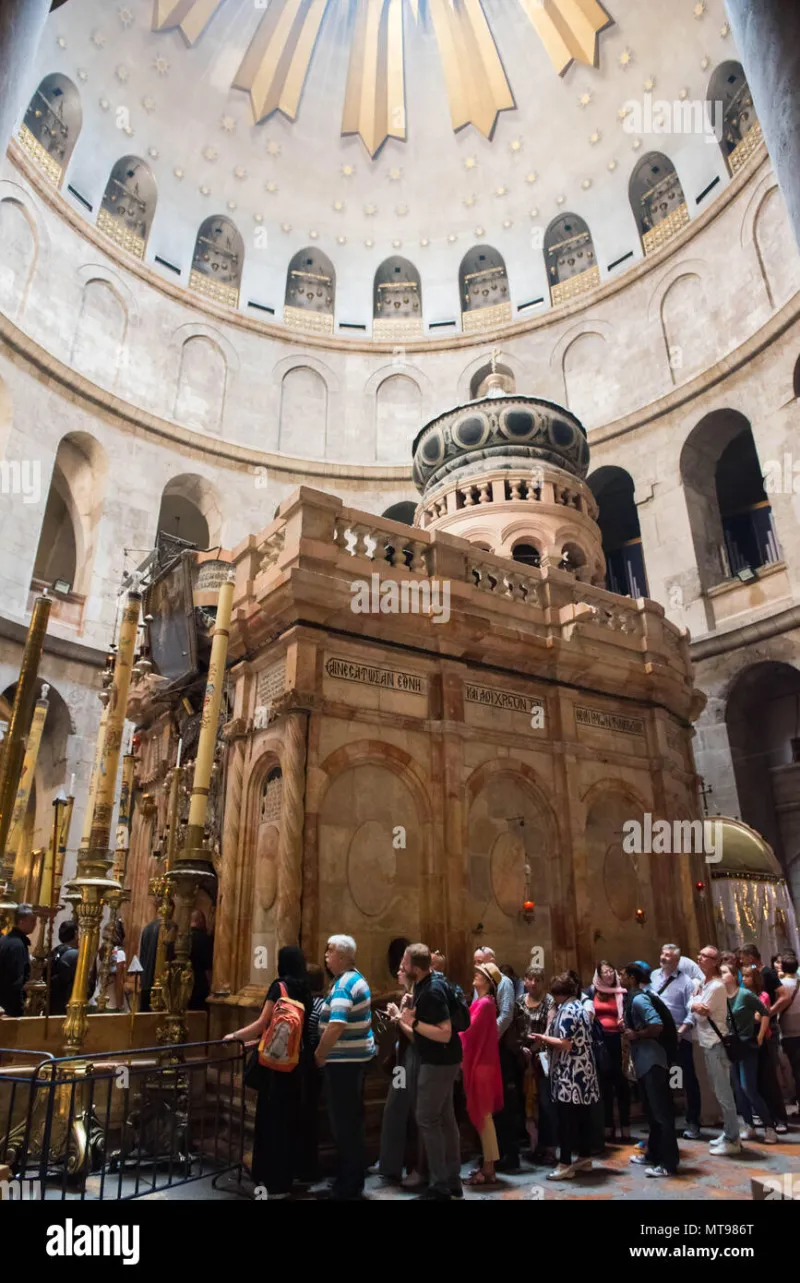
Photo: pilgrims praying inside Church of the Holy Sepulchre rotunda Jerusalem, via c8.alamy.com
Most American pilgrims arrive at the Church of the Holy Sepulchre after a long flight, a bus ride from Tel Aviv, and a walk through the labyrinthine lanes of the Old City's Christian Quarter. They are, quite often, exhausted. And then they round a corner and the church is simply there—unassuming from the outside, with a twelfth-century Crusader façade and a door that opens onto the site of the crucifixion and the burial of Christ.
A first visit deserves better than a hurried checklist. Here is what experienced pilgrims and guides wish every American knew before going.
Choose Your Hour Wisely
The single most important planning decision is timing. The church opens early—typically around 4:00 or 5:00 a.m., depending on the season—and the hours immediately after opening are transformative. You may share the rotunda with only a few dozen worshippers and the sound of morning offices. By mid-morning, tour groups arrive in waves, and the queue for the Edicule, the shrine enclosing the tomb, can stretch over an hour.
If your schedule allows, consider visiting twice: once at dawn for solitude and again later to witness the church in its full, bustling, multinational life. Pilgrims who see only the crowds often leave with the wrong impression; those who see only the quiet miss half the story.
A Note on Holy Fire Weekend
The Holy Fire ceremony, held the Saturday before Orthodox Easter (usually falling a week or more after the American Easter), draws tens of thousands of worshippers into the church and the surrounding streets. It is one of the most extraordinary devotional gatherings in the Christian world—and an unwise setting for a first visit. Attendance requires arriving many hours in advance, standing for the duration, and accepting crush-level crowds. First-time visitors, particularly older travelers or those with young children, should plan their trip outside this window and experience the ceremony through the many documented accounts instead.
Getting Around: Accessibility and the Older Traveler
The Old City's streets are stone, uneven, and frequently stepped—wheelchairs and walkers face real challenges in the Christian Quarter itself. Inside the church, the situation is mixed. The main rotunda and the Edicule area are reachable at ground level, and church staff and guides are generally accommodating, but Golgotha is accessible only by a steep staircase, and the underground chapels involve additional stairs. Travelers with limited mobility should consider hiring a licensed private guide who can time visits around crowds and arrange assistance, and should know that benches in the rotunda are limited and fill early.
Etiquette in a Six-Denomination House
The church is shared by six Christian communities, each with its own liturgy, language, and schedule. A few courtesies go a long way:
- Dress modestly. Covered shoulders and knees are the norm throughout the Holy Land's holy sites.
- Speak quietly, especially near chapels where services are in progress. You will likely pass through an Armenian mass, a Catholic procession, and an Orthodox vespers within a single hour.
- Do not photograph worshipers' faces without asking, and never during the most solemn moments of a service.
- Keep moving in the Edicule queue, and keep it brief at the tomb itself—pilgrims behind you are waiting for the same thirty seconds of prayer you are.
- Expect the unexpected. Bells, incense, chanting in Greek, Arabic, Armenian, and Latin may all overlap. This is not disorder. It is the church's ordinary voice.
Beyond the Checklist
The pilgrims who return from Jerusalem changed are rarely the ones who saw the most sites. They are the ones who sat on a stone in the rotunda for an unplanned hour, or returned to the church on their free afternoon just to be there. Build that unstructured time into your itinerary. The Church of the Holy Sepulchre is not a monument to be verified; it is a place that rewards lingering. Give it the one thing your itinerary will fight you for: time.