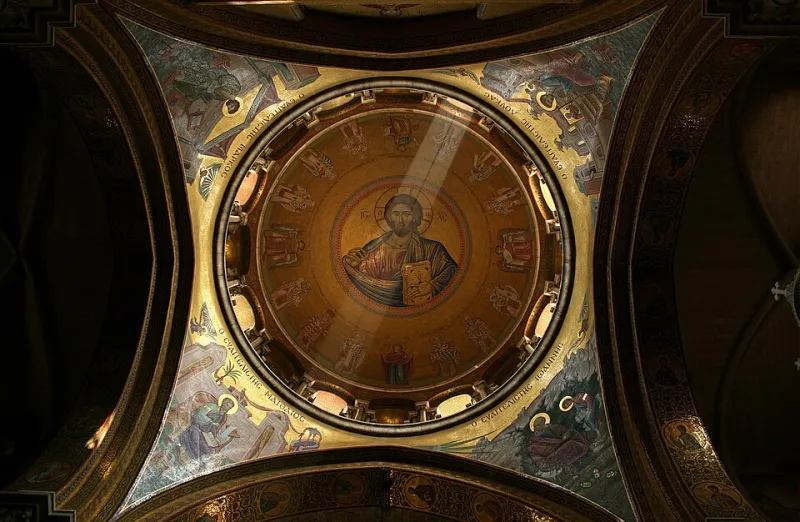
Built to Last: How Christianity's Holiest Shrine Outlived Empires, Earthquakes, and Centuries of Conflict
Photo: Seán Pòl Ó Creachmhaoil, CC BY-SA 4.0, via Wikimedia Commons
There is a particular kind of resilience that belongs only to places — a quality embedded in stone and mortar that outlasts the intentions of those who built, burned, and rebuilt them. The Church of the Holy Sepulchre in Jerusalem possesses this quality in extraordinary measure. Over the course of roughly two thousand years, it has been razed, reconstructed, seized by foreign powers, fractured by internal disputes, and battered by natural disaster. Yet it endures. For American Christians who often wrestle with questions of faith under far less dramatic pressures, the survival story of this sacred site carries a weight that is at once historical and deeply personal.
A Foundation Laid in Imperial Ambition
The church's origins lie in an act of deliberate reclamation. In the early fourth century, the Roman Emperor Constantine ordered the excavation of a site in Jerusalem that had been buried beneath a pagan temple — itself constructed, some historians believe, precisely to suppress Christian veneration of the location. What emerged from that excavation, according to the accounts of Eusebius of Caesarea, was the very tomb believed to be that of Jesus of Nazareth.
Constantine's Basilica of the Holy Sepulchre, consecrated in 335 CE, was a structure of breathtaking ambition: a complex of colonnaded halls, open courtyards, and a rotunda enclosing the tomb itself. It was built not merely as a place of worship but as a declaration — that the Roman Empire had placed its considerable weight behind the Christian faith. That political dimension, while sometimes uncomfortable to modern sensibilities, proved to be one of the church's earliest survival mechanisms. Imperial patronage provided both the resources and the motivation to protect and maintain the site through its earliest centuries.
The First Great Destruction — and What Followed
The church's first catastrophic destruction came in 614 CE, when Persian forces under Khosrow II swept through Jerusalem and burned the basilica to its foundations. The loss was devastating, but the response was telling. Within a generation, the Byzantine Empire, under Emperor Heraclius, had recaptured Jerusalem and overseen a significant reconstruction. The pattern was established early: destruction would be met with rebuilding, each cycle of loss followed by an act of communal determination to restore what had been lost.
The most complete demolition came in 1009, when the Fatimid Caliph Al-Hakim bi-Amr Allah ordered the systematic destruction of the church, including an attempt to cut down the very rock of the Edicule — the small shrine enclosing the tomb. The damage was severe enough that it helped galvanize support in Western Europe for the First Crusade, launched nearly a century later. When Crusader forces took Jerusalem in 1099, they undertook a sweeping reconstruction that produced the Romanesque church whose basic floor plan still defines the structure visitors encounter today.
That Crusader-era building was itself a masterwork of architectural consolidation, bringing together under a single roof the disparate sacred sites — Golgotha, the tomb, the place of the Finding of the Cross — that had previously occupied separate structures. By unifying these spaces, the Crusaders created something more durable than any of its individual components: a complex so layered with meaning that its total destruction became almost inconceivable.
Surviving Through Shared Stewardship
Perhaps the most counterintuitive source of the church's resilience is the very arrangement that most often strikes outside observers as a source of dysfunction. The Status Quo — the Ottoman-era agreement that divides custodial rights among six Christian denominations, including the Greek Orthodox, Roman Catholic, and Armenian Apostolic churches — has frequently generated friction and occasional embarrassment. Disputes over repair schedules, the famous immovable ladder on the façade, and competing liturgical calendars are well documented.
Yet this shared stewardship has also functioned as a form of distributed preservation. No single political or ecclesiastical power has ever held sufficient control over the church to impose its will entirely — which means no single power has ever been in a position to neglect or destroy it unilaterally. The very competition among denominations has, paradoxically, kept each one vigilant. When the Edicule underwent its most recent major restoration, completed in 2017, it required the cooperation of all the major custodians — a feat of ecumenical diplomacy that speaks to a deeper, shared investment in the site's survival.
Fire, Earthquake, and the Limits of Stone
Natural forces have repeatedly tested the church's physical fabric. A catastrophic fire in 1808 devastated the Rotunda and the Edicule, melting lead roofing and collapsing structural supports. The reconstruction that followed, largely undertaken by the Greek Orthodox community, produced the existing Edicule — a structure that subsequent engineers have described as architecturally precarious, held together in recent centuries partly by an iron cage installed by British authorities in 1947 following an earthquake.
The 2017 restoration, led by a team from the National Technical University of Athens, revealed just how close the Edicule had come to catastrophic collapse. Workers found the original burial bench of Jesus for the first time in centuries, sealed beneath marble slabs. The discovery was a reminder that the church's survival is not passive — it requires active, technically sophisticated intervention from each generation that inherits its care.
A Metaphor American Christians Can Carry Home
For the millions of American Christians who will never make the journey to Jerusalem, the survival story of the Church of the Holy Sepulchre offers something that transcends geography. Faith communities across the United States have navigated their own cycles of crisis and renewal — congregations that have survived schism, communities that have rebuilt after fire or flood, traditions that have been challenged by cultural change and emerged transformed rather than destroyed.
The church in Jerusalem does not survive because it is invulnerable. It survives because each generation has chosen, often at considerable cost, to restore what was broken. That choice — repeated across centuries and across the divisions of denomination, empire, and culture — is perhaps the most sacred thing the building contains.
To stand inside the Church of the Holy Sepulchre is to stand inside a record of those choices. The stones are not merely old; they are testimonies. And for a faith tradition built on the conviction that death is not the final word, there may be no more fitting monument than a structure that has refused, again and again, to stay buried.