The Quiet Alliances of the Holy Sepulchre: Pastors, Gatekeepers, and Monks in the Spaces Between Disputes
The headlines about the Church of the Holy Sepulchre tend to focus on conflict. There are disputes over calendars, repairs, processions, and the famous ladder above the entrance. All of that is real. Yet the church also runs on something less dramatic: ordinary relationships among people who do not agree on everything but have learned to share a building.
Those relationships are not a solution to the institutional tensions. They are something more modest and more durable. They are the small alliances that keep the place functioning, day after day, between the grand arguments.
The Gatekeeper's Chair
At the entrance, a Muslim gatekeeper holds a position that has become one of the most recognizable offices in the church. The role is often associated with the Nuseibeh and Judeh families, custodians whose service stretches across centuries. For visitors, the gatekeeper can seem like a ceremonial figure. In practice, the work is practical: opening, closing, managing crowds, and keeping the threshold orderly.
American pastors often arrive expecting a lecture on the Status Quo. What they find is a person with a chair, a schedule, and a set of daily courtesies. A nod, a greeting, a moment of patience in a crowded courtyard. These are not theological agreements. They are the habits of people who share a doorway.
A Monk's Small Courtesies
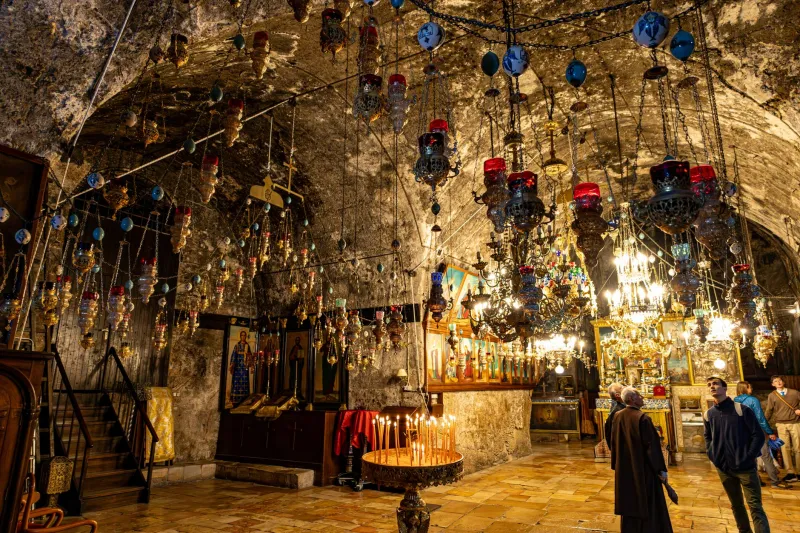
Inside the church, the daily round belongs to several communities. Greek Orthodox, Armenian, Franciscan, Coptic, Syriac, and Ethiopian clergy all maintain presences under arrangements that are often described as complicated and are sometimes experienced as exhausting. Yet the same monks and priests who defend their community's rights also learn the practical grammar of coexistence.
An Armenian monk may step aside for a Franciscan procession. A Greek Orthodox sacristan may offer a visiting American pastor a glass of water. A custodian may move a chair so an elderly pilgrim can sit. These gestures do not erase theological differences. They simply make the shared space livable.
An American Pastor's Education
Many American pastors come to the Holy Sepulchre with ecumenical hopes or apologetic instincts. They want to understand the disputes, or perhaps to resolve them in a seminar. The building tends to resist that ambition. It teaches a different lesson: how to be faithful within a situation one cannot control.
A Baptist pastor from Texas may find himself in a conversation with a Greek Orthodox deacon about the practicalities of crowd flow. A Methodist group leader may learn to time a visit around the Armenian liturgy. These exchanges are not doctrinal dialogues. They are the kind of working relationships that develop when people share a hallway, a schedule, and a common desire to keep worship going.
Kindness Without Agreement
The most important thing about these relationships is that they do not require agreement. The gatekeeper does not become an honorary monk. The monk does not become a gatekeeper. The American pastor does not become an expert in Eastern canon law. What emerges instead is a form of civility that is sturdier than sentiment because it is practiced under pressure.
This matters for American congregations because the church in the United States often struggles with the difference between unity and uniformity. The Holy Sepulchre offers no easy model of merger. It offers something more attainable: the possibility of kindness without agreement, cooperation without compromise on essentials, and daily patience with people whose convictions differ.
What Ordinary Cooperation Teaches
The quiet alliances of the Holy Sepulchre are easy to overlook because they do not produce dramatic photographs. They produce something else: a church that can still open its doors, a liturgy that can still be sung, and a pilgrim who can still find a place to pray. In a building defined by centuries of tension, that is no small achievement.
For visitors from the United States, the lesson is not that institutional conflict is harmless. It is that conflict is never the whole story. Alongside the disputes, there are people making room for one another. That ordinary kindness is not a distraction from the sacred. It is one of the ways the sacred is sustained.