Sacred Illumination: How Light Has Spoken to Pilgrims at the Church of the Holy Sepulchre Across the Centuries
Photo: SpicyVoice, CC BY-SA 4.0, via Wikimedia Commons
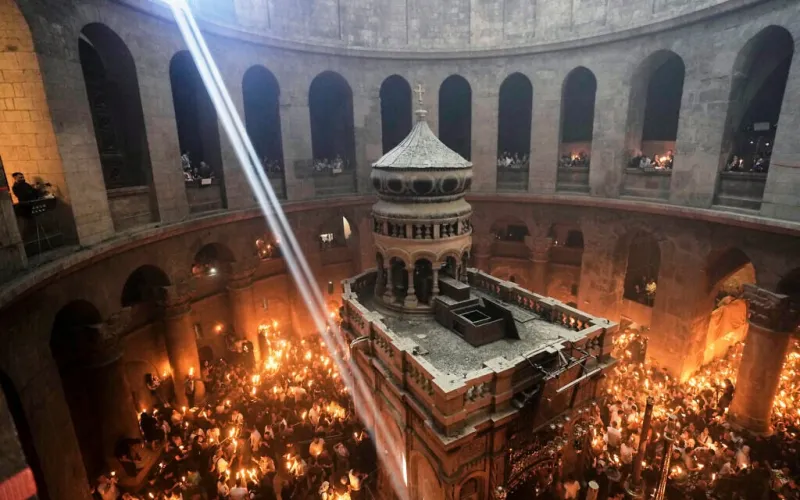
There is a moment, familiar to nearly every American pilgrim who has entered the Church of the Holy Sepulchre, that no guidebook quite prepares them for. It arrives not at the Tomb itself, nor at the gilded surface of the Stone of Anointing, but in a quieter instant — when a shaft of morning light descends through one of the church's high windows and falls, with an almost startling precision, across the ancient stone floor. In that moment, many visitors report that something shifts. Words become unnecessary. The body stills. A kind of listening begins.
This experience is not accidental. It is, in the most literal sense, by design.
An Architecture Built Around Revelation
When Constantine's architects broke ground on the original basilica in the fourth century, they were working within a theological framework that regarded light as a direct expression of divine presence. The Gospel of John had already established the metaphor with unambiguous force: In him was life, and that life was the light of all mankind. For early Christian builders, the window was not merely a structural aperture — it was a theological instrument.
The rotunda that shelters the Edicule, the small chapel encasing the tomb itself, was designed to receive a single dramatic beam of sunlight through an oculus positioned directly above. This circular opening in the dome, drawing on both Roman and early Christian architectural traditions, was intended to create what scholars of sacred architecture describe as a "vertical axis" — a visual and spatial line connecting the earthly worshipper to the heavens above. Standing beneath it, pilgrims from Jerusalem's earliest Christian centuries would have understood immediately that they were meant to look up.
Subsequent reconstructions — following the destruction ordered by Caliph Al-Hakim in 1009 and the extensive Crusader rebuilding of the twelfth century — each preserved and elaborated this commitment to purposeful illumination. The Crusaders, drawing on Romanesque and early Gothic sensibilities developing simultaneously in Western Europe, introduced lancet windows and refined the placement of apertures to ensure that different hours of the day would bathe different portions of the church in shifting qualities of light.
What the Hours Reveal
The church does not look the same at seven in the morning as it does at noon, and it bears almost no resemblance to itself in the late afternoon. This is not incidental variation — it is a liturgical calendar written in photons.
Early morning light in the church tends to be cool and diffuse, filtering through eastern apertures to cast long, pale geometries across the floor of the katholikon, the central nave. Pilgrims who arrive at dawn for the opening of the great wooden doors often describe this quality of light as contemplative, even austere — an invitation to interior silence rather than active prayer. By mid-morning, as the sun climbs over the Old City, warmer tones begin to enter through windows oriented to the south and southeast, and the atmosphere of the space transforms perceptibly. The golden hues that fall across the Crusader columns and the worn marble pavements carry a quality that many worshippers associate with warmth, welcome, and the presence of something benevolent.
For American visitors accustomed to the controlled, artificial lighting of contemporary church architecture back home — the recessed LED fixtures and the carefully calibrated spotlights of modern sanctuaries — this dynamic, living illumination frequently arrives as a revelation. Numerous pilgrims have described it as their first encounter with a worship space that feels genuinely alive, responsive to the passage of time in a way that deepens rather than interrupts their prayer.
What Neuroscience Has Begun to Confirm
In recent years, researchers studying the intersection of environment and spiritual experience have begun to document what pilgrims have reported for centuries. Studies in environmental psychology and cognitive neuroscience have demonstrated that natural light, particularly light that varies in color temperature and intensity, measurably affects mood, attentiveness, and what researchers term "self-transcendent experience" — the subjective sense of moving beyond the boundaries of the individual self.
Dr. Andrew Newberg, a neuroscientist at Jefferson University in Philadelphia whose research focuses specifically on the neurology of religious experience, has argued that certain environmental conditions — including dramatic, directional natural light — activate neural pathways associated with awe, emotional openness, and heightened perceptual sensitivity. These are precisely the conditions that the architects of the Church of the Holy Sepulchre, working centuries before the advent of brain imaging technology, appear to have cultivated with remarkable intentionality.
The implications are striking. What Byzantine and Crusader builders encoded into stone and glass through theological instinct and accumulated liturgical wisdom, contemporary science is now able to describe in the language of synapses and cortical activity. The two vocabularies are different. The phenomenon they describe appears to be the same.
The Candle as Complement
Natural light alone does not tell the complete story of illumination at the Church of the Holy Sepulchre. The church's interior is also shaped by the warm, unsteady glow of hundreds of oil lamps and votive candles that burn continuously around the Edicule and at the various altars maintained by the six Christian communities that share custodianship of the site. These flames, many of which are never extinguished, create a counterpoint to the movement of the sun — a constant, human-tended luminescence that persists through the night and into the hours when natural light is absent.
For many American pilgrims, the act of lighting a candle at the Church of the Holy Sepulchre carries a significance that transcends the gesture itself. It is, in a sense, a participation in the church's continuous ministry of light — a small, personal contribution to an illumination that has been maintained, without interruption, for generations beyond counting.
A Conversation Still Ongoing
The windows of the Church of the Holy Sepulchre have outlasted the empires that built them, the conflicts that threatened them, and the theological controversies that have periodically divided the communities that worship beneath them. They have admitted light into a space where, according to the faith of billions, the darkness was permanently and decisively overcome.
For the pilgrim who stands in the church today — whether arriving from Chicago or Charlotte, from a lifelong tradition of Christian practice or from a place of genuine seeking — the light that enters through those ancient openings carries the accumulated weight of every prayer ever offered beneath it. It falls on the same stones. It illuminates the same tomb.
And in that continuity, something speaks that no sermon, no commentary, and no guidebook has ever fully managed to translate.