What Your Body Knows at the Tomb: The Sensory Language of Pilgrimage in Jerusalem
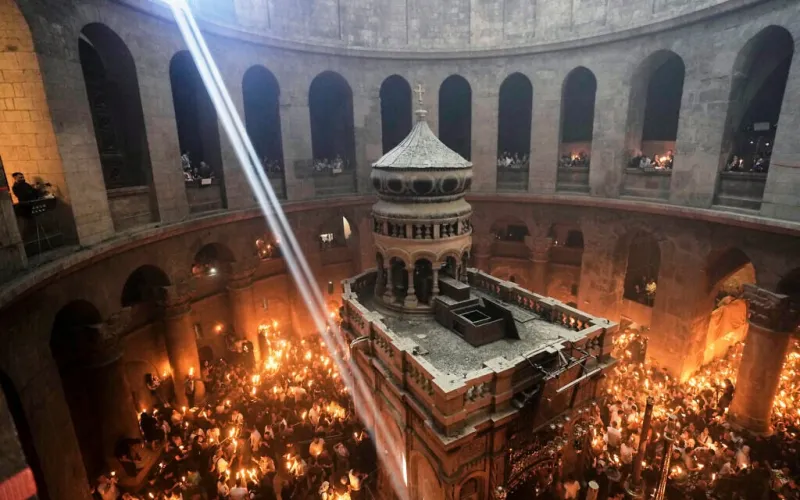
Photo: pilgrims praying candlelight incense inside Jerusalem holy church stone walls, via static-cdn.toi-media.com
Susan Calloway, a high school teacher from Columbus, Ohio, had visited countless churches in her life. She had prayed in grand cathedrals and modest suburban sanctuaries, in chapels and fellowship halls, in spaces that moved her and spaces that left her cold. Nothing, she says, prepared her for the moment she stepped through the low entrance of the Edicule — the small marble shrine enclosing the tomb of Christ — inside the Church of the Holy Sepulchre.
"It wasn't a thought," she recalls. "It was something that happened to my body first. The smell, the heat of the candles, the feel of the stone under my hands. My mind caught up about thirty seconds later."
Calloway's experience is not unusual. Pilgrimage guides who lead American groups through the Church of the Holy Sepulchre year after year report a consistent pattern: visitors who have prepared intellectually and spiritually for the journey are nevertheless caught off guard by the sheer physical intensity of the encounter. The church, they discover, does not speak only to the mind. It speaks to every sense simultaneously — and that multisensory address, researchers and theologians are increasingly suggesting, may be precisely the point.
The Architecture of Sacred Sensation
The Church of the Holy Sepulchre was not designed to be visually simple. Its interior is a layered accumulation of centuries — Byzantine mosaics, Crusader stonework, Ottoman-era marble, Baroque altarpieces, and the perpetual shimmer of hanging oil lamps — that resists the kind of clean, uncluttered aesthetic that many American Christians associate with serious worship. First-time visitors frequently describe a moment of mild disorientation, a sense that the space is almost too much to take in.
This complexity is not accidental. The church's custodial communities — Greek Orthodox, Roman Catholic, Armenian Apostolic, Coptic, Ethiopian, and Syriac — each maintain their own liturgical spaces within the building, filling them with the particular visual and olfactory signatures of their traditions. The result is an environment of layered sensory richness that has no real equivalent in American religious architecture.
The incense is perhaps the most immediately striking element. Multiple denominations burn it continuously, and the cumulative effect in the Rotunda — the great domed space surrounding the Edicule — is a fragrance that is simultaneously ancient and alive. For many visitors, this scent becomes a permanent sensory memory, one that resurfaces unexpectedly for years afterward and carries with it the full emotional weight of the original experience.
What Neuroscience Tells Us About Sacred Space
The power of sensory experience in religious contexts is not merely anecdotal. Research in environmental psychology and the neuroscience of memory has produced a growing body of evidence that physical environments — their sounds, smells, temperatures, and textures — shape emotional and cognitive states in ways that purely intellectual engagement cannot replicate.
Dr. Rachel Herz, a neuroscientist who has studied olfactory memory extensively, has noted that smell is the only sense that bypasses the thalamus and connects directly to the brain's limbic system — the region most closely associated with emotion and long-term memory. This neurological shortcut may help explain why the incense of the Church of the Holy Sepulchre so frequently triggers responses that visitors describe as involuntary: tears, a sudden sense of peace, or what one pilgrim from Nashville called "a feeling of being recognized by something much older than myself."
Beyond smell, the church engages the body in ways that modern American worship spaces rarely attempt. The stone floors are uneven and worn; visitors feel the history of the place literally beneath their feet. The air temperature shifts noticeably as one moves from the bright chaos of the entrance courtyard into the cool dimness of the interior. The Edicule itself requires physical humility — its entrance is low enough that most adults must bow their heads to enter, a posture that carries unmistakable symbolic resonance.
Preparing the Senses Before You Arrive
Experienced pilgrimage guides increasingly advise American visitors to prepare not just spiritually and logistically but sensorially. This preparation takes several forms.
Some guides recommend that pilgrims spend time in the weeks before departure attending liturgies in traditions different from their own — Eastern Orthodox services, for instance, or a High Mass with incense — to begin acclimating their senses to a mode of worship that engages the body more fully than many American Protestant or evangelical services typically do. Others suggest keeping a sensory journal during the trip itself, recording not just what was seen but what was smelled, touched, and heard at each site.
Mark Hendricks, a pilgrimage guide who has led groups from across the American Midwest and South to Jerusalem for more than a decade, puts it plainly: "The people who get the most out of the Church of the Holy Sepulchre are the ones who've given themselves permission to stop managing the experience and just let it happen to them. The building will do the work, if you let it."
Hendricks also prepares his groups for the noise. The church is rarely silent; on any given day, multiple liturgies may be occurring simultaneously in different chapels, and the sound of chanting, bells, and the movement of large crowds fills the space in a way that can feel overwhelming to visitors accustomed to quiet, contemplative worship environments. Learning to find stillness within that sound, rather than waiting for the sound to stop, is itself a form of spiritual practice.
The Stone Beneath the Hand
Among the most reported transformative moments for American pilgrims is the act of touching the Stone of Anointing — the long marble slab near the entrance of the church, traditionally associated with the preparation of Christ's body for burial. Pilgrims kneel and press their hands, their foreheads, and sometimes their faces against its surface. The stone is cool and smooth, polished by centuries of exactly this contact.
For many visitors, this is the moment when the church's history becomes physically real in a way that no amount of reading or screen-based preparation could produce. The stone is not a replica or a reproduction. It is a place where human grief and hope have been deposited, in the form of touch, for hundreds of years. To add one's own hands to that accumulation is to participate in something that extends far beyond any individual act of prayer.
"I'd read about it, I'd seen photos," says David Morales, a pastor from San Antonio who visited the church for the first time two years ago. "But when I put my hand on that stone, I understood something I hadn't understood before. I'm not sure I can say what it was, exactly. But it was real."
Coming Home Changed
The lasting effects of a multisensory pilgrimage to the Church of the Holy Sepulchre are difficult to quantify but consistently reported. Visitors describe a heightened attentiveness to the physical dimensions of their faith — a new appreciation for the role of the body in worship, a greater comfort with silence and with mystery, and a renewed sense of connection to the global and historical community of Christian belief.
For a generation of American Christians navigating the pressures of digital life — where spiritual content is often consumed on screens, in isolation, without physical community — the Church of the Holy Sepulchre offers something genuinely countercultural: a space that insists on your presence, in the fullest possible sense of the word.