The Virtual Pilgrim: Can a Screen Bring You Closer to the Empty Tomb?

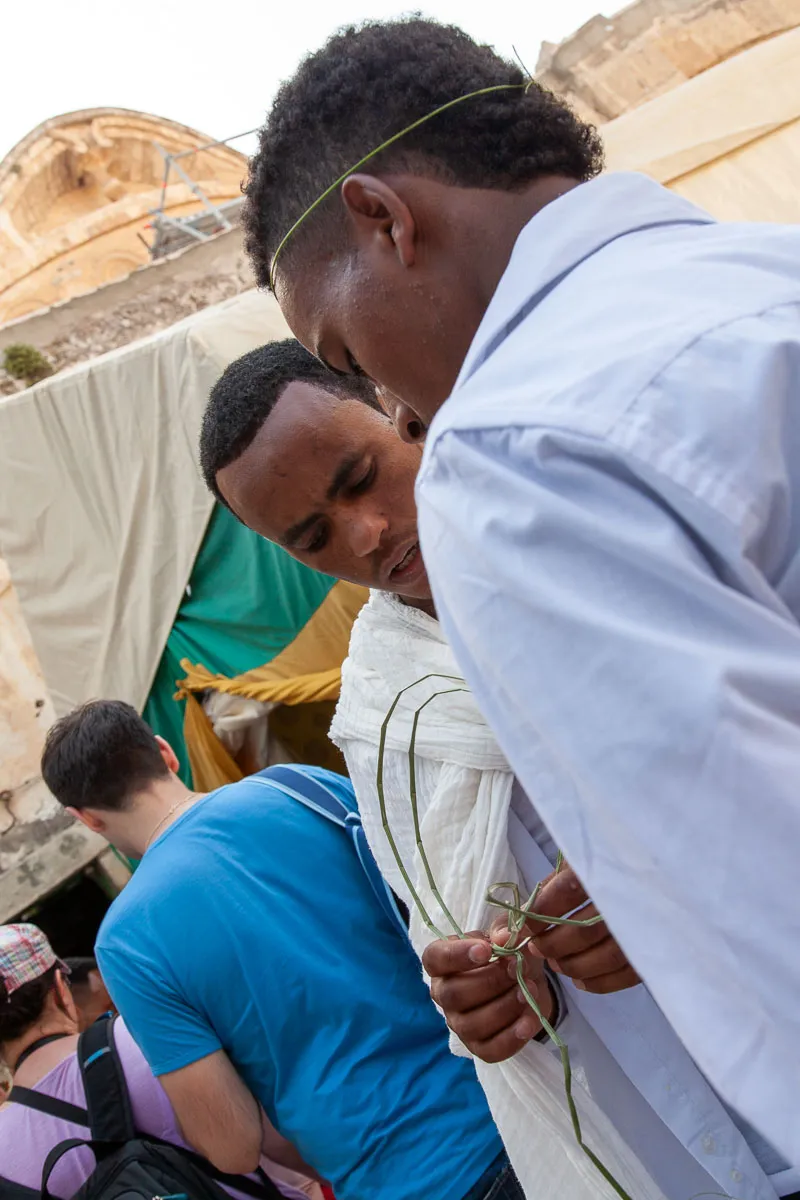
Photo: Kwameghana(Bright Kwame Ayisi), CC0, via Wikimedia Commons
Susan Hartley, a retired schoolteacher from Columbus, Ohio, had wanted to visit Jerusalem for as long as she could remember. She had saved for years, researched tour operators, and even begun the process of renewing her passport. Then a health diagnosis intervened, and the journey she had imagined for decades was placed indefinitely on hold.
"I was heartbroken," she recalls. "This was something I had carried in my heart since I was a girl in Sunday school. The idea that I might never stand in that place — it was a real grief."
A few months later, a friend sent her a link to a high-definition virtual tour of the Church of the Holy Sepulchre. She opened it on a Tuesday evening, sitting in her living room in central Ohio, and spent two hours moving through the church's ancient corridors, zooming in on the stone of anointing, circling the Edicule, and reading the historical notes embedded in the interface. When she finally closed her laptop, she sat quietly for a long moment.
"It wasn't the same," she says. "But it was something. It was genuinely something."
The Digital Threshold
Susan's experience is increasingly common among American Christians who feel a deep spiritual connection to the Church of the Holy Sepulchre but face practical barriers to physical travel. International airfare, the cost of guided tours, physical limitations, and the demands of work and family all conspire to keep the majority of the faithful in their home pews rather than Jerusalem's Old City.
Into that gap, technology has stepped with remarkable speed. In recent years, a range of digital tools has emerged that allow Americans to engage with the Church of the Holy Sepulchre in ways that were unimaginable even a decade ago. High-resolution virtual tours, some developed in partnership with academic institutions, allow users to navigate the church's interior with a level of visual detail that rivals many in-person visits. Scholarly digital archives maintained by universities and religious organizations provide access to historical records, photographic collections, and archaeological reports that were once available only to specialists.
YouTube channels and livestreamed services broadcast liturgical celebrations directly from the church to devices in American living rooms, kitchens, and hospital rooms. During Holy Week, viewership numbers for these streams regularly climb into the tens of thousands.
Community Without Coordinates
Beyond the individual experience of virtual exploration, a broader ecosystem of online community has developed around the Church of the Holy Sepulchre and Jerusalem pilgrimage more generally. Facebook groups dedicated to Christian travel to the Holy Land count hundreds of thousands of members, many of whom have never made the journey and participate primarily through shared photographs, historical discussions, and personal reflections.
Reddit communities, podcast series, and YouTube documentaries have created what researchers of digital religion describe as "networked sacred spaces" — environments in which the emotional and spiritual texture of a physical place is partially reconstructed through shared media and collective engagement. For participants, these communities can provide a genuine sense of connection to the site and to one another.
Pastor Marcus Webb of a mid-sized evangelical congregation in suburban Atlanta has incorporated virtual exploration of the Church of the Holy Sepulchre into his adult education programming. "We use it as a teaching tool, absolutely," he explains. "But I've also watched people have genuine emotional responses — tears, silence, a sense of awe. I don't dismiss that."
What Technology Cannot Replicate
Yet scholars of pilgrimage and religious experience are careful to distinguish between digital engagement and the full embodied experience of sacred travel. The tradition of Christian pilgrimage to Jerusalem stretches back to at least the fourth century, when Helena, mother of the Emperor Constantine, is said to have traveled to the Holy Land to identify and venerate the sites of Christ's life and death. From its earliest articulations, pilgrimage theology has emphasized the irreplaceable significance of physical presence — the act of walking where Jesus walked, touching the stone where his body was laid, breathing the same air as countless generations of the faithful before.
Dr. Elena Vasquez, a scholar of religious studies at a research university in the American Southeast, notes that pilgrimage has traditionally been understood as a transformative journey in which the physical difficulty of travel is itself spiritually meaningful. "There is a theology of the body embedded in pilgrimage," she observes. "The aching feet, the disorientation, the sensory overwhelm of the church itself — these are not incidental. They are part of how the experience reshapes the pilgrim."
A virtual tour, however beautifully rendered, cannot replicate the smell of incense accumulated over centuries, the press of other pilgrims' bodies in a narrow corridor, or the startling darkness of the church's interior after the bright Jerusalem sun. These sensory dimensions are not merely atmospheric — they are, for many pilgrims, the very medium through which spiritual transformation occurs.
A Both/And Proposition
The most thoughtful voices in this conversation tend to resist framing digital and physical pilgrimage as competing alternatives. Rather, they suggest, digital engagement may serve a genuinely valuable preparatory and supplementary function — deepening the spiritual readiness of those who will eventually travel, and providing meaningful connection for those who cannot.
Several pilgrimage organizations that lead American tour groups to Jerusalem have begun incorporating pre-trip digital immersion into their programs, encouraging participants to spend time with virtual tours, historical podcasts, and online reading before departure. The feedback, tour operators report, is that digitally prepared pilgrims arrive with a richer contextual understanding and a greater capacity to absorb the experience of the church itself.
For those who will never make the physical journey, the question of whether digital engagement constitutes a "real" pilgrimage may ultimately be less important than whether it produces genuine spiritual fruit — a deepened sense of connection to the tradition, a more vivid understanding of the faith's historical roots, a renewed commitment to prayer and community.
Susan Hartley, for her part, has continued her virtual engagement with the Church of the Holy Sepulchre. She has joined an online community of American Christians who share her interest, completed a self-guided digital study course on the church's history, and begun corresponding with a woman in Arizona who shares her situation. She keeps the hope of a physical visit alive, though she holds it more gently now.
"I think God meets us where we are," she says. "I believe that. And sometimes where we are is a Tuesday evening in Ohio with a laptop."
The empty tomb, after all, was not made sacred by the presence of any particular pilgrim. It was made sacred by an absence — and perhaps it is that paradox, more than any technology, that allows it to be encountered from anywhere on earth.