Ancient Hours, American Lives: How Jerusalem's Sacred Calendar Is Reshaping Christian Worship Across the United States
On a Tuesday morning in suburban Nashville, a small group of believers gathers before sunrise. They are not monks. They are not clergy. They are teachers, nurses, and accountants who have quietly restructured their days around a liturgical calendar rooted not in their own denomination's tradition, but in the ancient rhythms still observed inside the Church of the Holy Sepulchre in Jerusalem. They pray at fixed hours. They mark the seasons of the Christian year with deliberate ceremony. And they do so with one eye, spiritually speaking, turned eastward toward the city where Christianity began.
This is not an isolated phenomenon. Across the United States—from evangelical megachurches in Texas to small Catholic parishes in New England, from independent house churches in the Pacific Northwest to mainline Protestant congregations in the Mid-Atlantic—a growing number of American Christians are looking to Jerusalem's most sacred site not merely as a destination for pilgrimage, but as a living model for worship itself.
A Church That Has Never Stopped Praying
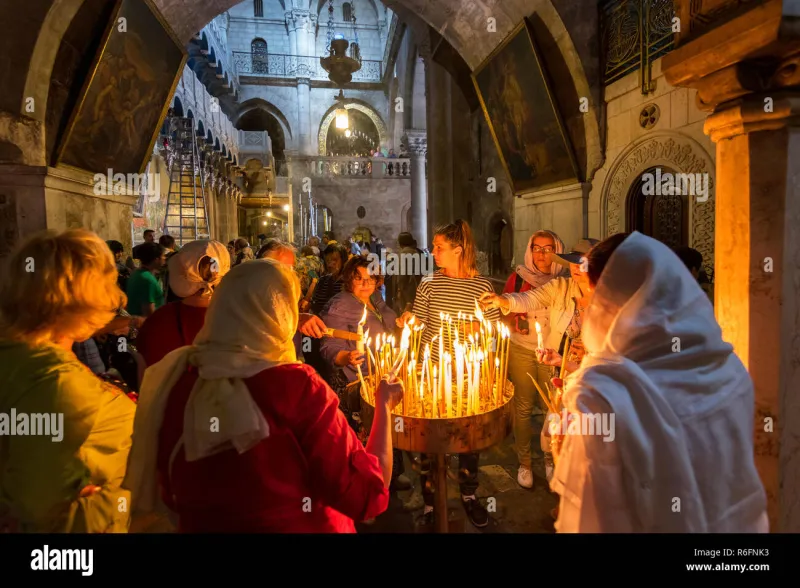
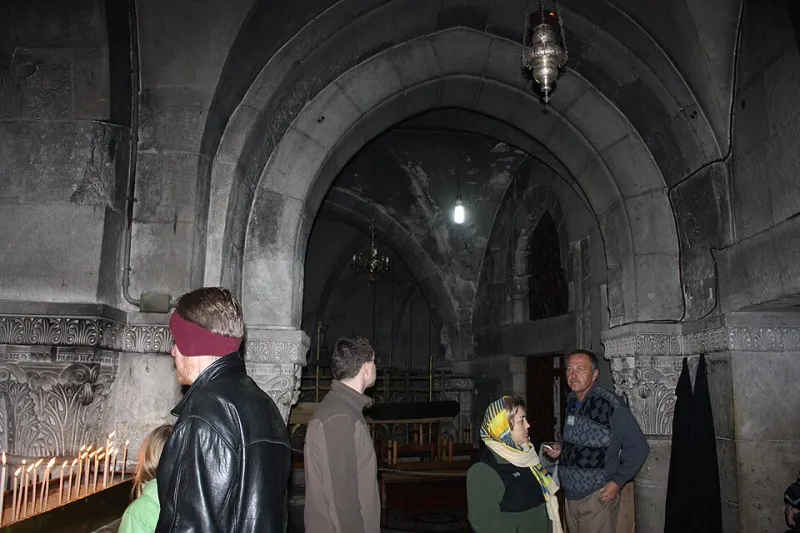
The Church of the Holy Sepulchre has maintained an unbroken liturgical life for centuries. Within its walls, six Christian communities—Greek Orthodox, Roman Catholic, Armenian Apostolic, Coptic, Ethiopian Orthodox, and Syriac Orthodox—observe their own distinct rites, yet together they sustain a continuous rhythm of prayer, procession, and seasonal celebration that predates many of the traditions American Christians consider foundational.
The liturgical calendar observed at the Holy Sepulchre is not simply a schedule of religious holidays. It is a theological architecture—a structured way of inhabiting time that moves a worshipping community through the entire narrative of Christian faith across the course of a single year. Advent anticipation, the solemnity of Holy Week, the jubilation of Pascha: each season carries its own spiritual texture, its own set of bodily practices, its own call to transformation.
For American Christians accustomed to worship experiences organized primarily around individual preference or congregational convenience, this kind of structured, communal time-keeping can feel both foreign and profoundly compelling.
The Pull of Palm Sunday
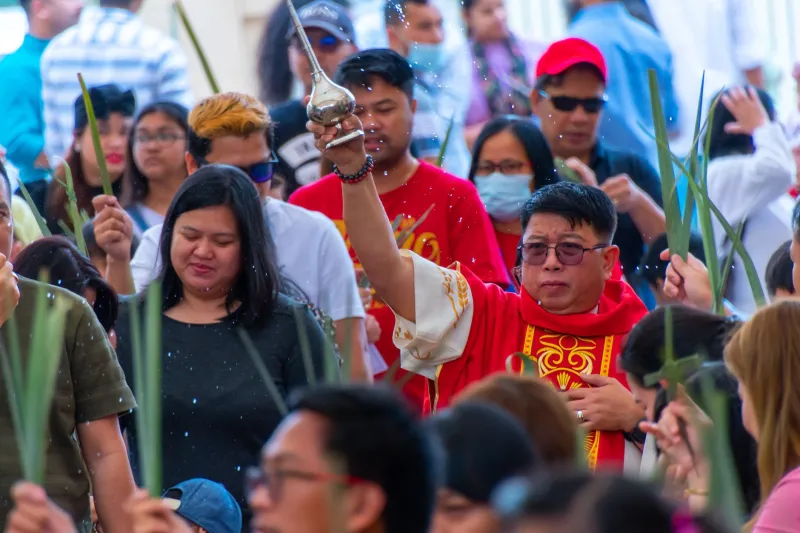
Few moments in the Jerusalem liturgical year draw more attention from American observers than the Palm Sunday procession from the Mount of Olives to the Old City. Tens of thousands of pilgrims—many of them American—participate each year, walking the same route that Christian communities have followed since at least the fourth century. The procession is not a reenactment. It is a continuation.
For many American participants, this experience becomes a turning point. Returning home, they find themselves unwilling to reduce Palm Sunday to a brief distribution of palm fronds before a Sunday sermon. They begin to ask what it might mean to truly inhabit the week that follows—to treat Holy Monday, Holy Tuesday, and Holy Wednesday as spiritually distinct days rather than ordinary weekdays that happen to precede Easter.
Pastors and spiritual directors across the country report that this hunger for liturgical depth has intensified noticeably over the past decade. "People come back from Jerusalem and they've experienced something they can't quite name," says one Episcopal priest in Chicago. "They've been inside a place where the faith is still being lived at full volume, in real time, and they want to bring some of that home."
The Holy Fire and the Question of Sacred Time
Perhaps no ceremony in the Jerusalem liturgical year captures the American Christian imagination more vividly than the Holy Fire, observed each Holy Saturday within the Church of the Holy Sepulchre. In this ancient rite, a flame is said to emerge miraculously from within the Edicule—the small shrine enclosing the traditional site of Christ's tomb—and is passed rapidly through the church and then outward to the waiting world.
For Eastern Christians, the Holy Fire is among the most sacred moments of the liturgical year. For many Western Christians, it remains largely unknown. Yet interest among American believers has grown substantially, driven in part by video footage shared widely across social media and in part by the accounts of pilgrims who have witnessed the ceremony firsthand.
What draws people is not merely the spectacle. It is the theological claim embedded in the ritual: that sacred time is not simply commemorative, but participatory. The Holy Fire does not merely remember a resurrection. It enacts, in some sense, the ongoing reality of that resurrection within the community of faith.
This understanding of time—cyclical, participatory, oriented toward a sacred center—stands in contrast to the predominantly linear and individualistic framework within which much of American Christian worship operates. For believers seeking an alternative, the liturgical calendar of the Holy Sepulchre offers a coherent and ancient model.
Syncing to Jerusalem Time
The phrase "Jerusalem time" has begun to circulate informally among American Christians engaged in this kind of liturgical reorientation. It refers not to a clock but to a posture—a willingness to let the sacred calendar of the world's most historically layered Christian site set the tempo for one's own spiritual life.
Practically, this takes many forms. Some American believers observe the Liturgy of the Hours, praying at fixed points throughout the day in a pattern that mirrors the structured prayer life maintained by the communities residing within the Holy Sepulchre. Others follow the Eastern Orthodox or Armenian liturgical calendars, which align more closely with the rites practiced at the church. Still others simply commit to marking the full sweep of the Christian year—not just Christmas and Easter, but Epiphany, the Transfiguration, the Exaltation of the Holy Cross—with intentional prayer and communal observance.
Digital tools have made this more accessible than ever. Apps that provide daily readings from the Jerusalem Lectionary, online communities that gather virtually to observe the major feasts of the Holy Sepulchre's liturgical tradition, and live-streamed ceremonies from within the church itself have all lowered the barrier to participation for American believers who cannot travel to Jerusalem in person.
What Ancient Rhythms Offer a Restless Culture
The appeal of this movement is worth examining honestly. American culture in the twenty-first century is marked, among other things, by a pervasive sense of temporal fragmentation—the feeling that time is simultaneously accelerating and dissolving, that days blur together without meaningful shape or sacred punctuation. Against this backdrop, the disciplined liturgical calendar of the Church of the Holy Sepulchre offers something countercultural: a way of living in time that is ordered, communal, and oriented toward something larger than the self.
There is also, for many American Christians, a profound hunger for connection to the earliest layers of Christian history. The Church of the Holy Sepulchre is not simply old. It stands on the site where, according to the witness of the Christian tradition, the central events of human redemption took place. To pray according to its rhythms is, in some sense, to pray in continuity with every generation of believers who has gathered there since the fourth century.
That continuity, fragile and remarkable in equal measure, is precisely what draws an increasing number of American Christians to orient their spiritual lives by Jerusalem time—not as an act of nostalgia, but as an act of living faith.