Two Sites, One Cross: How American Pilgrims Are Learning to Sit With Sacred Uncertainty at Golgotha
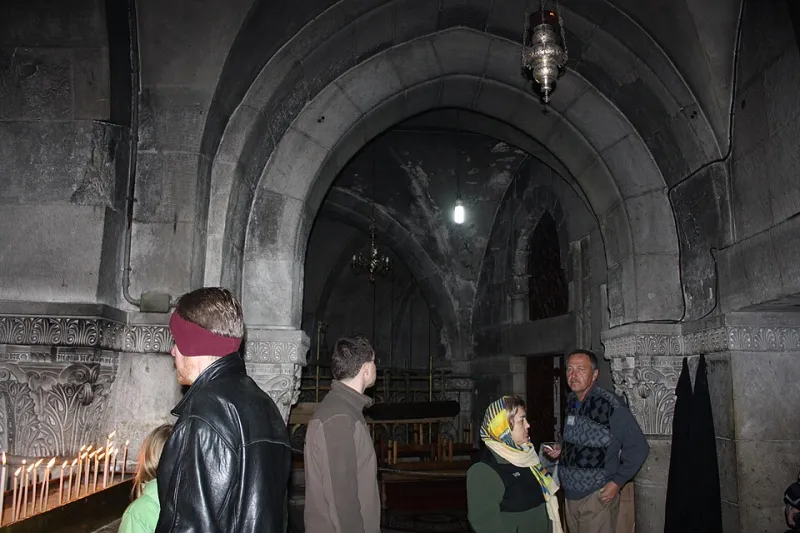
Photo: Wknight94 talk, CC BY-SA 3.0, via Wikimedia Commons
For many Americans who make the journey to Jerusalem, the itinerary reads like a checklist of certainties. They expect to stand on the ground where the crucifixion happened, to touch the stone where the body of Jesus was laid, and to peer into the tomb where the resurrection unfolded. What they often do not expect is ambiguity — the kind that does not dissolve with more research or a better guidebook, but deepens the longer you stay.
The question of where, precisely, Jesus was crucified has occupied scholars, clergy, and pilgrims for nearly two millennia. Inside the Church of the Holy Sepulchre, the site venerated by Catholic and Orthodox traditions as the authentic Golgotha rises in the form of a rocky outcropping enclosed within the basilica's upper chapel. A few miles north of the Old City, the Garden Tomb — a site championed predominantly by Protestant visitors since the nineteenth century — offers a quieter, garden-enclosed alternative. For American pilgrims shaped by different denominational backgrounds, arriving at Jerusalem can feel less like reaching an answer and more like walking into the middle of an argument that no one has yet won.
What the Church of the Holy Sepulchre Actually Claims
The veneration of the site within the Church of the Holy Sepulchre as the location of both the crucifixion and the burial of Jesus is not a medieval invention. Archaeological and historical evidence supports the view that this location was already regarded as sacred by the earliest Christian communities in Jerusalem. When the Emperor Constantine commissioned the original basilica in the fourth century, he did so in response to a tradition that had been preserved locally for generations.
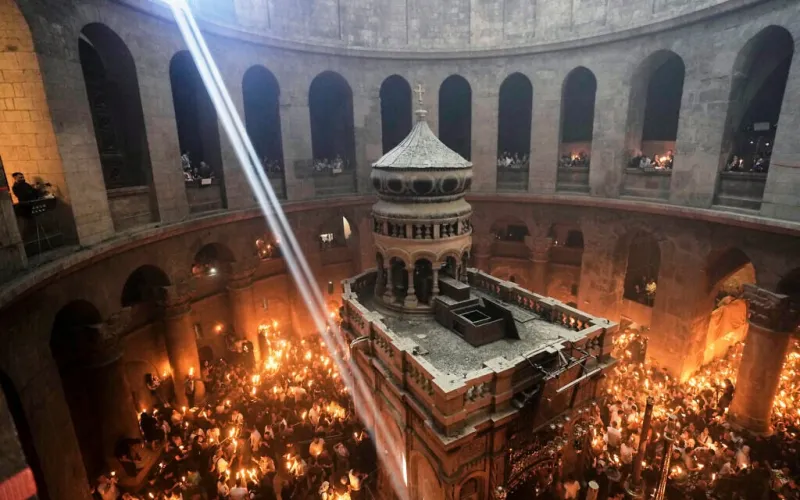
The rocky elevation within the church, now enclosed behind ornate altars and illuminated by hanging lamps, represents what generations of Eastern Orthodox and Roman Catholic pilgrims have accepted as Calvary. Beneath the altar in the Chapel of the Crucifixion, a small opening in the floor allows pilgrims to reach down and touch the bare rock itself — a gesture that connects the present moment to the geological reality of a hill outside Jerusalem's ancient walls.
Yet American visitors, many of them raised in Protestant traditions that have historically approached sacred sites with greater skepticism, often find themselves uncertain. The elaborate ornamentation, the incense, the competing liturgical sounds from multiple Christian communities sharing the same roof — none of it matches the spare, sunlit image of Golgotha that Sunday school lessons and Hollywood films have deposited in the American imagination.
The Garden Tomb and the Protestant Imagination
The Garden Tomb, identified in 1883 by British General Charles Gordon as a possible site of the crucifixion and burial, has become the preferred destination for many evangelical and Protestant pilgrims from the United States. Its appeal is not primarily archaeological — the scholarly consensus does not favor it as the authentic site — but experiential. The open garden, the visible rock face, and the accessible tomb chamber create an atmosphere that feels, to many American visitors, more intuitively biblical.
This preference reveals something important about how American Protestant culture has historically engaged with the Holy Land. The emphasis on a direct, unmediated encounter with scripture has often translated into a preference for sites that feel unencumbered by institutional religion. A garden tomb surrounded by flowers reads differently, emotionally, than a candlelit chapel crowded with icons.
But scholars and theologians across traditions caution against allowing aesthetic preference to substitute for historical inquiry. The Church of the Holy Sepulchre's location, counterintuitive as it may seem to visitors who expect to find it outside the modern city walls, is actually consistent with what is known about Jerusalem's topography and the placement of the city's ancient walls at the time of the crucifixion. The site was, in the first century, outside the walls — precisely as the Gospel accounts require.
What Pilgrims Say When They Return
Conversations with American pilgrims who have visited Jerusalem reveal a striking pattern. Those who arrive expecting historical certainty often depart with something more difficult to categorize — and, many of them report, more valuable.
A retired schoolteacher from Ohio described standing at the Golgotha altar inside the Church of the Holy Sepulchre and feeling unexpectedly moved, not despite the ornate surroundings, but because of the sheer weight of accumulated devotion she could sense in the stone beneath her hands. "I kept thinking, millions of people have knelt right here," she said. "And that felt true in a way that the debate about which site is correct suddenly didn't."
A pastor from suburban Atlanta described a different response — an initial frustration with the competing claims that gradually gave way to what he called "a more honest faith." "I realized I had been looking for a museum exhibit with a label that said 'This Is Where It Happened,'" he reflected. "What I found instead was a living argument among people who all care desperately about the same thing. That felt closer to the New Testament than I expected."
These accounts are not unusual. For many American pilgrims, the Golgotha question functions less as an obstacle to faith and more as an invitation to examine what kind of faith they arrived with.
Precision and Presence
The deeper theological question lurking beneath the geographical dispute is whether sacred pilgrimage is fundamentally about confirming historical facts or about entering into a different quality of attention. Christian traditions have long distinguished between the two without resolving the tension between them.
The Church of the Holy Sepulchre does not ask its visitors to abandon historical curiosity. The ongoing archaeological work within and beneath the basilica reflects a serious institutional commitment to understanding what lies beneath the centuries of construction and reconstruction. But the church also embodies a tradition that has never reduced the meaning of a sacred site to its GPS coordinates.
For pilgrims willing to hold both impulses simultaneously — the scholarly and the devotional, the questioning and the reverent — the Golgotha question becomes something other than a problem to be solved. It becomes a threshold.
The Gift of Not Knowing
There is a long tradition within Christian spirituality, honored across Catholic, Orthodox, and Protestant streams, of what theologians sometimes call apophatic knowing — the recognition that the most important truths exceed the categories we bring to them. Standing at Golgotha, wherever one locates it, may be less about arriving at a correct answer than about being genuinely altered by the question.
American culture does not always prepare its pilgrims for this kind of encounter. The preference for resolution, for definitive answers and clear narratives, is deeply embedded in the way most US visitors approach both travel and faith. Jerusalem, and the Church of the Holy Sepulchre in particular, has a way of quietly dismantling those expectations.
What remains, for many who make the journey, is not certainty but something that functions more powerfully than certainty — a sense of having stood in a place where the weight of history and the depth of longing converge in ways that no competing claim can fully contain or diminish.
The cross, after all, was never primarily a geographical coordinate. It was an event that the earliest witnesses struggled to describe in language adequate to its meaning. That struggle, it turns out, has not ended. It simply moved indoors.