A Thousand Years of Whispered Names: What It Means to Pray Inside the Church of the Holy Sepulchre
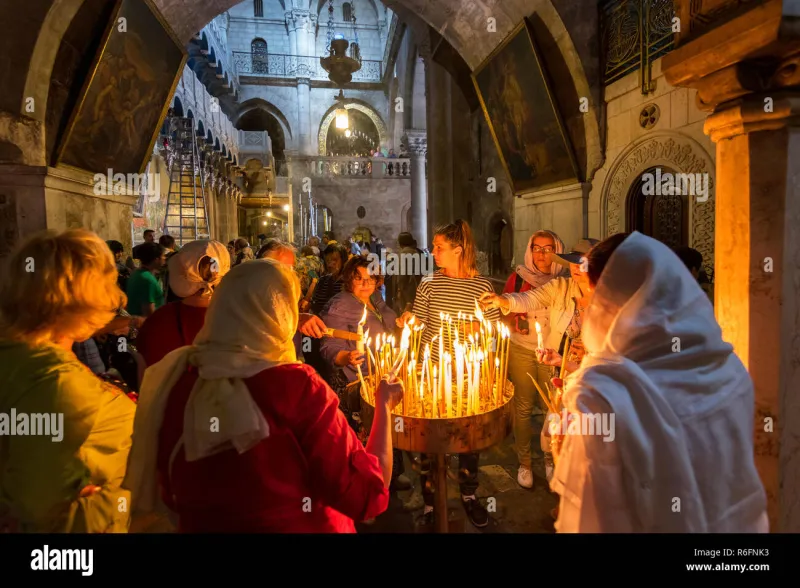
Photo: pilgrims praying inside Church of the Holy Sepulchre Jerusalem rotunda candlelight, via c8.alamy.com
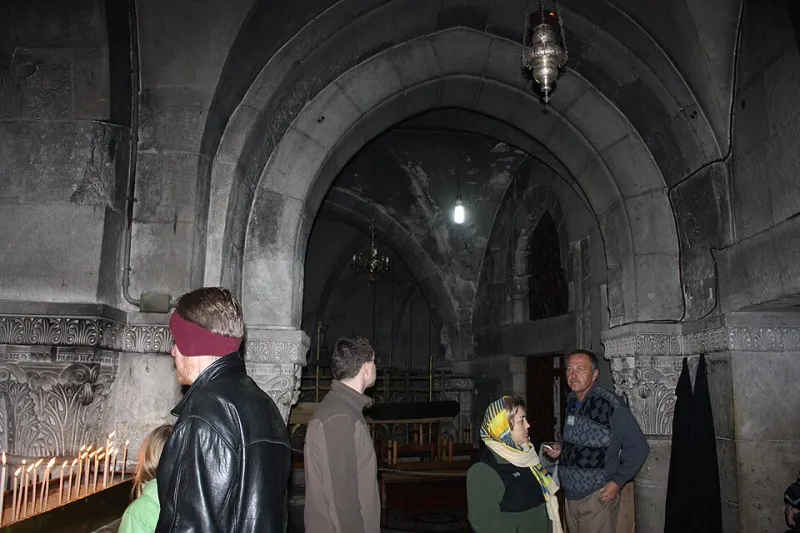
There is a moment that many American pilgrims describe in nearly identical terms, though they arrive at the Church of the Holy Sepulchre from vastly different traditions and with vastly different expectations. They step through the low, arched entrance off the courtyard in the Christian Quarter of Jerusalem, and something shifts — not dramatically, not with thunder, but quietly and with unmistakable force. The space, they say, feels inhabited. Not by other visitors, though those are plentiful. By something older.
What they are sensing, at least in part, is architecture. But it may also be something that architecture alone cannot explain.
Stone That Has Heard Everything
The current structure of the Church of the Holy Sepulchre traces its essential form to the Crusader reconstruction of the twelfth century, though significant portions rest on foundations laid during the reign of Constantine the Great in the fourth century. For roughly 1,600 years, this building has functioned as an active site of Christian worship — not intermittently, not ceremonially, but continuously, with multiple liturgical communities observing daily prayer within its walls.
The Greek Orthodox, Roman Catholic, Armenian Apostolic, Coptic, Ethiopian, and Syriac Orthodox communities each maintain custodial rights over distinct portions of the church, and each community conducts its own liturgical cycle. At any given hour of the day, it is possible to hear chanting in Greek, Latin, Armenian, Coptic, Ge'ez, or Aramaic — sometimes simultaneously, drifting through the rotunda and the side chapels in overlapping waves.
For a visitor from the American Midwest or the Pacific Northwest, accustomed to a single Sunday service in a single language, the effect can be disorienting in the most productive sense of that word. The church does not orient you toward one tradition. It holds them all, imperfectly and gloriously, under one roof.
What Acoustics Can and Cannot Measure
Architectural acousticians who have studied the Church of the Holy Sepulchre note that the rotunda — the great domed structure that rises above the Edicule, the shrine enclosing the tomb itself — creates a reverberant acoustic environment of considerable complexity. Sound produced beneath that dome does not dissipate quickly. It lingers, reflects off curved stone surfaces, and mingles with subsequent sound before fading. The practical effect is that a voice spoken or sung inside the rotunda carries farther and sustains longer than it would in an open space of comparable volume.
This is measurable physics. What is rather more difficult to measure is the cumulative spiritual weight that centuries of prayer have deposited in a place. Theologians across traditions have long debated whether physical spaces can be sanctified — whether repeated acts of worship alter a location in any meaningful sense beyond the symbolic. The Church of the Holy Sepulchre has served, across those debates, as something of an extreme case study. If any building on earth might bear the imprint of accumulated devotion, this would be the candidate.
Many pilgrims do not frame the question in theological terms at all. They simply report that the church feels different from other churches. Heavier. More present.
American Voices Joining an Ancient Conversation
For American Christians making the journey to Jerusalem — a pilgrimage that has grown substantially in the past two decades, with organized tours departing from evangelical megachurches in Texas, Catholic parishes in the Northeast, and mainline Protestant congregations throughout the South — the moment of entering the Church of the Holy Sepulchre often arrives after considerable preparation. Travelers have read the history, watched the documentaries, spoken to friends who have gone before them. And yet the experience consistently exceeds expectation.
A retired schoolteacher from Ohio who visited the church as part of a Baptist pilgrimage group described standing at the entrance to the Edicule, waiting her turn to enter the tomb chamber, and becoming aware of the sound around her. "There was chanting somewhere behind me," she recalled. "And someone near me was crying quietly. And I could hear a group praying in what I think was Spanish. And I thought — all of this has been happening here, in this exact spot, for longer than my country has existed. Longer than most countries have existed."
That awareness of temporal scale is a recurring theme among American pilgrims. The United States is a young nation by the standards of sacred history, and American Christianity, for all its vitality, is largely a tradition that was transplanted and reimagined in a new world. To stand in a place where Christians have prayed continuously since the age of Constantine is to encounter a dimension of the faith that can feel genuinely foreign — and, for many, genuinely transformative.
The Act of Adding Your Voice
The practical question that confronts every pilgrim is a simple one: what do you say? Visitors to the Church of the Holy Sepulchre bring prayer intentions gathered from their home communities — names of the sick, the grieving, the searching. They carry handwritten notes. They carry photographs. They carry the accumulated need of people who could not make this journey themselves and who asked, with varying degrees of solemnity, that someone pray for them here.
The tradition of intercessory prayer at sacred sites is ancient and cuts across denominational lines. In the context of the Church of the Holy Sepulchre, it takes on a particular texture. To kneel at the Stone of Anointing, or to reach into the marble recess inside the Edicule where tradition holds the tomb to have been, and to speak the names of people you love into that space — this is to participate in an act that has been performed by pilgrims from the Byzantine era forward. Crusader knights prayed here. Medieval mystics prayed here. Ordinary believers from every century of Christian history prayed here, in their own languages, carrying their own needs.
Your voice, however tentative, joins that continuity.
A Chorus Without a Conductor
What makes the Church of the Holy Sepulchre unusual among the world's great sacred sites is precisely its lack of a single governing voice. No one tradition controls the whole. No single liturgy defines the space. The Status Quo agreement that distributes custodial rights among six Christian communities produces, at times, an atmosphere of audible theological plurality — multiple choirs, multiple languages, multiple conceptions of what this place means and why it matters.
For some American visitors, particularly those from more uniform worship environments, this plurality can initially feel chaotic. Over the course of a visit, however, many report arriving at a different understanding. The competing prayers do not cancel one another out. They accumulate. They thicken the air in the rotunda. They remind the visitor that the Christian encounter with this place has never been simple, has never been singular, and has never stopped.
To pray here is not to pray alone, even if you arrive alone. It is to add one more voice to a conversation that began before the United States existed, before Europe as we know it existed, before most of the structures that frame modern life were imagined. That conversation continues, in Greek and Latin and Armenian and Ge'ez, every day, inside these ancient walls.