Behind the Locked Door: The Secret Spaces of Christianity's Holiest Church
Every year, millions of pilgrims pass through the great doors of the Church of the Holy Sepulchre in Jerusalem. They press their palms against the Stone of Anointing, they kneel inside the Edicule, and they climb the narrow stairs to Golgotha. What almost none of them realize is that the building they are moving through is, in significant ways, only partially known — even to those who govern it.
Behind certain walls, beneath specific floors, and beyond doors that have not swung open in decades, there are spaces that resist easy categorization. They are not exactly forbidden. They are not exactly forgotten. They exist in a peculiar institutional limbo, caught between competing ecclesiastical jurisdictions, unresolved archaeological questions, and the quiet weight of sacred tradition. For American visitors accustomed to the transparency of museum culture — to floor plans posted near the entrance and audio guides explaining every corner — the existence of such spaces can come as a genuine surprise.
A Building That Grew Over Centuries
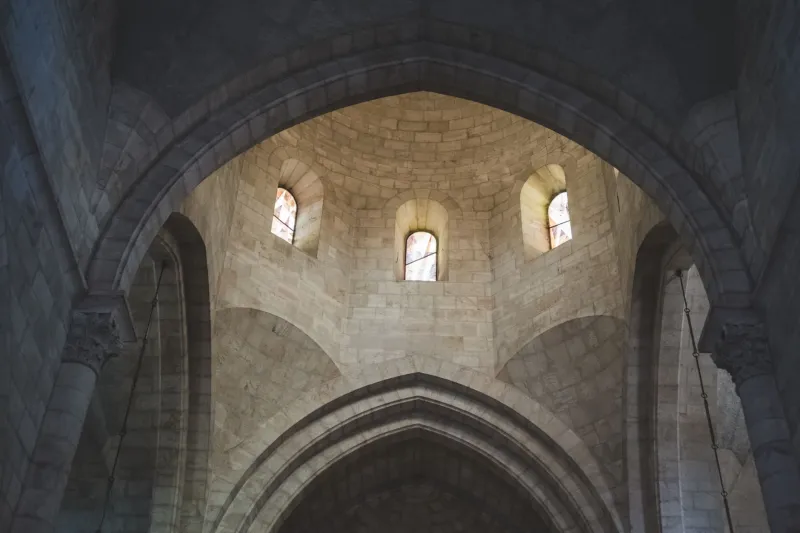
To understand why sealed chambers exist inside the Church of the Holy Sepulchre, it helps to understand the building's architectural biography. What stands today is not a single structure but a layered accumulation of construction, destruction, and reconstruction stretching back nearly two millennia. The original basilica commissioned by Emperor Constantine in the fourth century was largely dismantled by the Fatimid caliph Al-Hakim in 1009. The Crusaders rebuilt extensively in the twelfth century. Fires, earthquakes, Ottoman-era repairs, and a major restoration effort that began in the 1950s and continued for decades have all left their mark.
The result is a building with an extraordinarily complex interior geography. Stairways that once led somewhere now terminate at plastered walls. Arched doorways have been bricked over. Rooms that served liturgical functions in one era were absorbed, subdivided, or simply locked when the communities that used them shrank or shifted. The church is, in the words of one architectural historian, less a building than a sedimentary record.
The Coptic Chapel and the Wall It Shares
One of the most discussed restricted areas among scholars sits directly behind the Edicule — the ornate structure that encloses the tomb itself. The Coptic Orthodox Church maintains a small chapel pressed against the rear wall of the Edicule, a presence that reflects their ancient claim to a portion of the site. Within and adjacent to this chapel are areas that have not been formally surveyed or documented in any comprehensive way.
When the Greek Orthodox Patriarchate undertook restoration work on the Edicule between 2016 and 2017 — the most significant structural intervention in centuries — ground-penetrating radar and other non-invasive technologies revealed anomalies beneath the tomb chamber's floor. Researchers from the National Technical University of Athens identified what appeared to be an earlier tomb surface dating to the Byzantine period, and possibly to the original Constantinian construction beneath it. The full implications of those findings remain contested, and access to conduct further investigation has not been uniformly granted by all the custodial communities.
The Ethiopian Monastery and the Roof Above
Ascend to the rooftop of the Church of the Holy Sepulchre, and you enter a different world entirely. The Ethiopian Orthodox Tewahedo Church maintains a monastery there — a cluster of modest stone cells and a small chapel dedicated to Saint Michael — perched above the Chapel of Saint Helena. The community has occupied this space since at least the seventeenth century, when they lost their interior holdings due to a combination of debt and political circumstance.
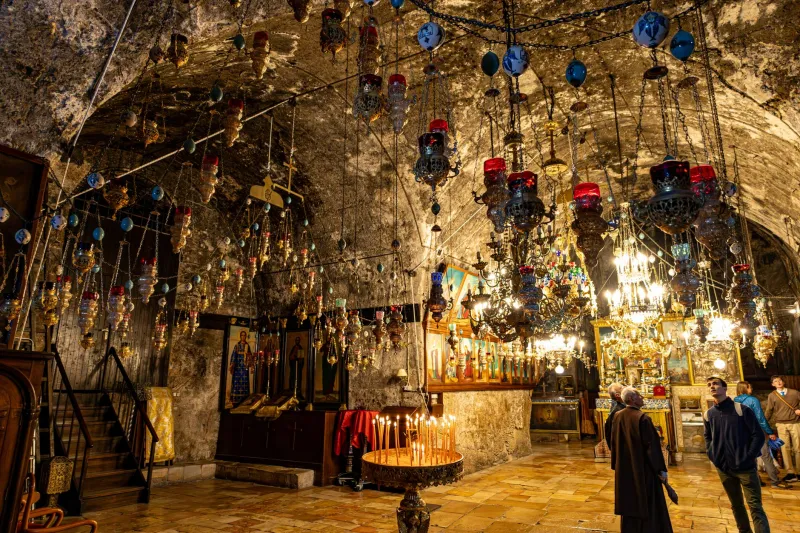
Beneath the Ethiopian monastery, accessible through interior passages that connect to the main church, lies the Chapel of Saint Helena — itself a significant archaeological zone. Below that chapel, reached by a further descent of stone stairs, is the Chapel of the Finding of the Cross, traditionally identified as the site where Helena, mother of Constantine, discovered the True Cross in the fourth century. The lower chambers in this sequence have been subject to periodic excavation, and cisterns, quarry cuts, and structural remains from multiple periods have been documented. However, portions of the underground complex remain incompletely mapped, and access for independent researchers requires negotiation with multiple parties.
Why the Doors Stay Closed
The reasons for restricted access are rarely sinister, though they are sometimes frustrating to outside observers. The church is governed under a centuries-old agreement known as the Status Quo, which assigns specific spaces and rights to six Christian communities: Greek Orthodox, Roman Catholic (Franciscan), Armenian Apostolic, Coptic Orthodox, Ethiopian Orthodox, and Syriac Orthodox. Any alteration to the physical fabric of the building — including opening a sealed door, removing a wall, or permitting an archaeological excavation — requires the consent of the relevant parties.
In practice, that consent is extraordinarily difficult to obtain. Disputes between communities have, famously, prevented even routine maintenance for years. The Status Quo, while preserving a fragile peace, also preserves the physical state of the building in ways that occasionally border on the absurd. The Immovable Ladder, a wooden ladder that has rested on a ledge above the main entrance since at least the eighteenth century, is the most cited example — but it is far from the only one.
For American pilgrims, accustomed to institutions that respond to public interest and scholarly inquiry with relative openness, this arrangement can feel opaque. It is worth understanding, however, that the communities who maintain these spaces are not being arbitrary. They are protecting claims that, in some cases, represent the entire territorial and spiritual inheritance of their tradition.
What May Yet Be Found
Archaeologists who have worked at the site speak carefully about what the sealed and restricted spaces might contain. The bedrock beneath the church preserves evidence of first-century quarrying activity consistent with the kind of garden-tomb landscape described in the Gospel accounts. Roman-era fill, medieval construction debris, and Byzantine mosaic fragments have all been recovered in areas where excavation has been permitted.
The more tantalizing possibility — one that researchers approach with appropriate caution — is that undisturbed stratigraphic layers survive beneath portions of the church that have not yet been systematically examined. If such layers exist, they could provide material evidence bearing on questions about the site's use and identity in the first century. They could also simply yield more medieval pottery. Archaeology rarely delivers the revelations that popular imagination expects.
The Spiritual Weight of the Unknown
For many Christian pilgrims, the existence of spaces beyond reach carries its own kind of meaning. There is a long tradition within Christian spirituality of holding mystery not as a problem to be solved but as a condition to be inhabited. The sealed passages and locked doors of the Church of the Holy Sepulchre become, in this reading, an extension of the site's essential character — a place where the most important events in the faith's history left traces that are only partially legible.
American visitors who have stood inside the Edicule often describe the experience as simultaneously overwhelming and incomplete. The tomb is smaller than they imagined. The marble slab covers whatever lies beneath. The answers, if there are answers, are not immediately available.
Perhaps that is precisely the point. The Church of the Holy Sepulchre has never been a site that yields itself entirely. Its hidden chambers are not an accident of institutional politics or architectural complexity alone. They are, in some sense, a feature — a reminder that the ground beneath the faithful has always held more than any generation has been able to see.